

A Baker’s cyst, also called a popliteal cyst, is a fluid-filled swelling behind the knee in the area known as the popliteal fossa. It forms when excess joint fluid from the knee pushes into a pouch at the back of the joint, usually because of an underlying problem such as knee osteoarthritis, a meniscus tear, or inflammatory arthritis. Symptoms include a soft lump behind the knee, tightness or stiffness, and pain on full bending or straightening. Diagnosis is confirmed with ultrasound or MRI, which also helps rule out a blood clot or tumour. Many cysts cause no symptoms and need no treatment. Painful cysts improve when the underlying knee problem is treated, with rest, ice, physiotherapy, aspiration, or a joint injection. A ruptured cyst can mimic deep vein thrombosis, so sudden calf pain and swelling need urgent evaluation. Surgical removal is rarely required.
A soft lump or swelling at the back of the knee is a common reason people visit an orthopedic clinic. In most cases, this lump is a Baker’s cyst, also known as a popliteal cyst. It is a pocket of joint fluid that bulges into the hollow behind the knee. A Baker’s cyst is not cancer and is rarely dangerous. It is usually a sign that something inside the knee joint is producing too much fluid.
What is a Baker’s Cyst?
A Baker’s cyst is a fluid-filled sac that develops behind the knee, in the diamond-shaped hollow called the popliteal fossa. The condition is named after Dr. William Morrant Baker, a 19th-century British surgeon who first described it. That is why it is sometimes called a “Morrant Baker’s cyst.”
The knee joint is lined by a membrane called the synovium, which produces synovial fluid. This fluid lubricates the joint and nourishes the cartilage. When the knee is irritated or damaged, it may produce too much fluid. This extra fluid can be pushed out through a small natural opening at the back of the joint into a bursa, a fluid sac that normally lies between the calf muscle and a hamstring tendon. A one-way valve effect often traps the fluid there, and the bursa swells into a cyst.
Baker’s cysts are most common in adults between 35 and 70 years of age, especially those with knee arthritis. They can also occur in children, usually without any underlying knee problem, and often disappear on their own.
Anatomy of the Popliteal Fossa
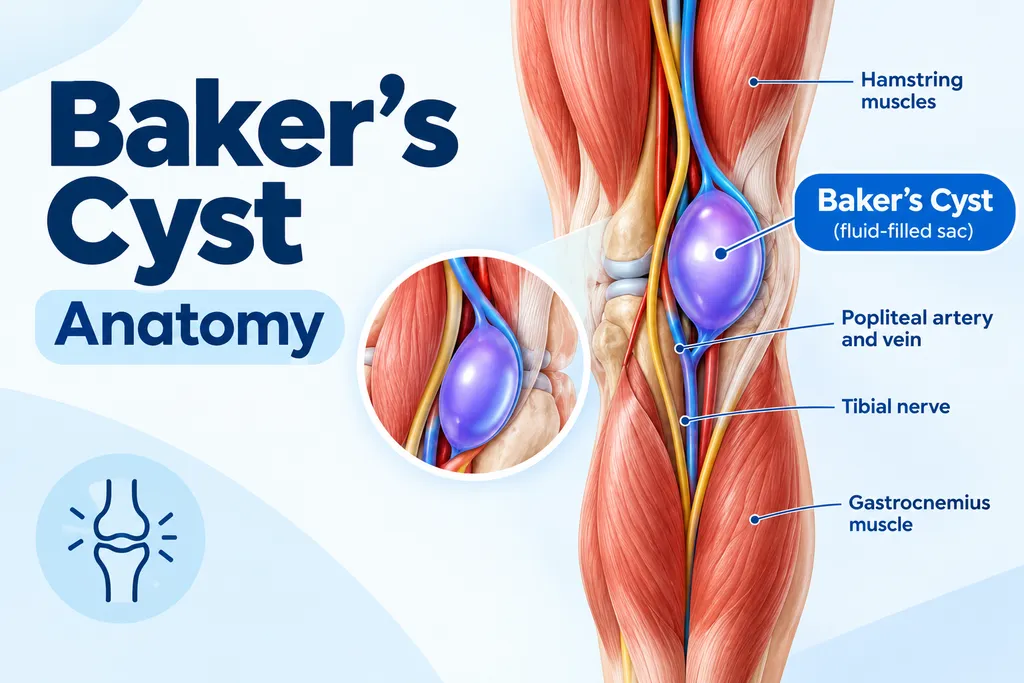
The popliteal fossa is the shallow hollow at the back of the knee. It contains several important structures:
- The popliteal artery and vein, the main blood vessels of the lower leg
- The tibial and common peroneal nerves
- Lymph nodes and fat
- Tendons of the hamstring and calf muscles
- The gastrocnemius-semimembranosus bursa, where most Baker’s cysts form
Because blood vessels and nerves pass through this space, any lump behind the knee needs proper evaluation. Most lumps turn out to be simple Baker’s cysts, but a few may be blood vessel swellings, blood clots, or, rarely, tumours.
Causes of Baker’s Cyst
In adults, a Baker’s cyst is almost always secondary to an underlying knee problem that causes excess joint fluid. Common causes include:
- Knee osteoarthritis, the most common cause in older adults
- Meniscus tears, especially tears at the back of the inner meniscus
- Rheumatoid arthritis and other inflammatory arthritis
- Gout and pseudogout
- Cartilage injury after sports or trauma
- Ligament injuries, such as an ACL tear, leading to chronic swelling
- Post-traumatic arthritis after an old knee fracture
- Knee joint infection, although this is uncommon
In children, Baker’s cysts are usually primary. They form without any obvious joint damage and often resolve without treatment.
Long-standing malalignment of the leg, such as bow legs, can overload one side of the knee. Over the years, this speeds up cartilage wear and arthritis, and a recurring joint effusion and Baker’s cyst can follow.
Symptoms of a Baker’s Cyst
Many Baker’s cysts cause no symptoms and are found by chance on an ultrasound or MRI done for another reason. When symptoms are present, they may include:
- A soft or firm lump behind the knee, more noticeable when standing
- A feeling of tightness or fullness at the back of the knee
- Stiffness and difficulty bending the knee fully
- Aching pain behind the knee, especially after activity
- Swelling that comes and goes with knee activity
- Symptoms of the underlying condition, such as knee pain, locking, or swelling in the joint
Large cysts can press on nearby veins or nerves. This may cause calf swelling, numbness, or tingling in the leg.
Ruptured Baker’s Cyst
Sometimes a Baker’s cyst bursts, and its fluid leaks down into the calf. A ruptured cyst can cause:
- Sudden sharp pain behind the knee or in the calf
- Swelling and tightness of the calf
- Redness or bruising around the ankle, sometimes called the “crescent sign”
- A feeling of water running down the calf
These symptoms look very similar to deep vein thrombosis (DVT), a blood clot in a leg vein that can be dangerous if it travels to the lungs. Anyone with sudden calf pain and swelling should be evaluated urgently. A Doppler ultrasound can tell the difference between a ruptured cyst and a blood clot. A ruptured cyst usually settles with rest, elevation, and pain relief over a few weeks.
Baker’s Cyst vs Other Causes of Swelling Behind the Knee

| Condition | Key Features | Test |
|---|---|---|
| Baker’s cyst | Soft lump, worse with standing, linked to knee arthritis | Ultrasound or MRI |
| Ruptured Baker’s cyst | Sudden calf pain, swelling, bruising at ankle | Ultrasound |
| Deep vein thrombosis | Calf pain, swelling, warmth, may follow surgery or immobility | Doppler ultrasound |
| Popliteal artery aneurysm | Pulsating lump behind the knee | Doppler ultrasound, CT angiography |
| Ganglion cyst | Firm lump near a tendon or joint | Ultrasound or MRI |
| Soft tissue tumour | Firm, growing, sometimes painless lump | MRI, biopsy |
How a Baker’s Cyst Is Diagnosed
Clinical Examination
The doctor examines the back of the knee with the leg straight and then bent. A Baker’s cyst usually feels firmer when the knee is straight and softens when it is bent. Shining a light through the lump (transillumination) may show that it is filled with fluid. The doctor also examines the whole knee to find the underlying cause, checking for arthritis, meniscus tears, ligament laxity, and joint swelling.
Imaging Tests
- Ultrasound is quick, inexpensive, and painless. It confirms that the lump is filled with fluid and helps rule out DVT
- MRI scan shows the cyst in detail and reveals the underlying cause, such as a meniscus tear or cartilage damage
- X-rays do not show the cyst itself, but they reveal knee arthritis, alignment problems, and bony changes
- Full-length standing X-rays may be advised when limb malalignment is suspected as a cause of one-sided knee arthritis
Treatment of a Baker’s Cyst
The most important principle is this: treat the knee, not just the cyst. If the underlying cause of excess joint fluid is controlled, the cyst often shrinks or disappears.
Observation
Small cysts that do not cause symptoms need no treatment. Many shrink over time, especially in children.
Conservative Care
For painful cysts, simple measures help:
- Rest and avoiding activities that worsen swelling, such as deep squatting and long periods of standing
- Ice packs for 15 to 20 minutes several times a day
- A compression bandage or knee sleeve
- Elevating the leg when resting
- Short courses of anti-inflammatory medicines under medical advice
Physiotherapy
Physiotherapy helps by improving knee range of motion, strengthening the quadriceps and hamstrings, reducing stiffness, and improving walking mechanics. This reduces stress on the knee joint and helps control fluid build-up.
Aspiration and Injection
When a cyst is large and painful, the doctor may drain the fluid with a needle under ultrasound guidance. A corticosteroid injection into the knee joint reduces inflammation and fluid production. This often gives good short-term relief. However, cysts can return if the underlying problem is not treated.
Treating the Underlying Knee Problem
Lasting control of a Baker’s cyst depends on addressing its cause:
- Meniscus tears may need arthroscopic repair or trimming
- Inflammatory arthritis is controlled with medications from a rheumatologist
- Knee osteoarthritis is managed with weight control, strengthening, and joint injections. In advanced cases, surgery may be needed
- One-sided knee arthritis caused by malalignment may benefit from a High Tibial Osteotomy, which shifts weight away from the damaged part of the knee and can reduce recurring joint swelling
Surgical Removal
Surgical removal of a Baker’s cyst is rarely needed. It is considered only when a large cyst keeps returning and causes significant symptoms despite treatment of the underlying knee problem. The cyst can be removed through an open incision behind the knee or treated arthroscopically by closing the valve-like opening between the joint and the cyst. Recurrence is common if the joint problem continues.
Recovery and Outlook
The outlook for a Baker’s cyst is generally very good:
- Many cysts shrink once knee inflammation is controlled
- Childhood cysts usually disappear within one to two years without treatment
- A ruptured cyst usually settles over two to four weeks with rest and elevation
- Aspiration and injection give relief for weeks to months
- Long-term control depends on treating the underlying knee condition
Living With a Baker’s Cyst: Practical Tips
- Avoid prolonged kneeling, deep squatting, and sitting cross-legged during flare-ups
- Maintain a healthy body weight to reduce load on the knees
- Stay active with low-impact exercise such as swimming, cycling, and walking
- Follow a regular quadriceps and hamstring strengthening routine
- Use ice and elevation when swelling increases
- Seek prompt medical help for sudden calf pain or swelling
When to See an Orthopedic Surgeon
Consult an orthopedic surgeon if:
- A lump behind the knee is painful, growing, or affecting movement
- The knee keeps swelling, locks, or gives way
- You have known knee arthritis with recurring swelling
- The lump is hard, pulsating, or growing quickly
- You experience sudden calf pain and swelling, which needs urgent evaluation to rule out a blood clot
Dr. Divya Ahuja, MS Ortho, is a Mumbai-based orthopedic and Ilizarov surgeon with over 15 years of experience in knee alignment, deformity correction, and complex orthopedic care. His practice at the Center for Limb Lengthening and Reconstruction, Mangal Anand Hospital, Chembur, evaluates swelling behind the knee, identifies the underlying joint problem, and offers ultrasound-guided aspiration, injections, and joint-preserving realignment surgery when malalignment is driving knee arthritis. For a consultation with an experienced orthopedic surgeon in Mumbai, you can book online or visit the clinic at Chembur, Thane, Dadar, Vashi, Navi Mumbai, or Tilak Nagar.
Conclusion
A Baker’s cyst is a common and usually harmless cause of swelling behind the knee. It is best understood as a warning sign from the knee joint rather than a disease of its own. Most cysts improve when the underlying arthritis, meniscus tear, or inflammation is treated, and surgery is rarely needed. Because sudden calf swelling can mean a ruptured cyst or a blood clot, it should never be ignored. If you lump or swelling behind your knee, consult Dr. Divya Ahuja for a careful evaluation, accurate diagnosis, and a treatment plan that addresses the root cause.
Frequently Asked Questions (FAQs)
What is a Baker’s cyst?
A Baker’s cyst, also called a popliteal cyst, is a fluid-filled swelling behind the knee. It forms when excess joint fluid collects in a pouch at the back of the knee, usually because of arthritis, a meniscus tear, or another knee problem.
Why is it called a Baker’s cyst?
It is named after Dr. William Morant Baker, a British surgeon who described the condition in the 19th century. This is why it is sometimes called a Morant Baker’s cyst. Its medical name is popliteal cyst, after the popliteal fossa.
What causes a Baker’s cyst?
In adults, Baker’s cysts are usually caused by knee conditions that produce excess joint fluid, such as osteoarthritis, meniscus tears, rheumatoid arthritis, gout, or cartilage injury. In children, they often form without any underlying problem and usually disappear on their own.
Is a Baker’s cyst dangerous?
A Baker’s cyst is not cancerous and is usually harmless. However, a large or ruptured cyst can cause significant pain and calf swelling that looks like a blood clot. Any sudden calf pain and swelling should be checked urgently by a doctor.
What are the symptoms of a Baker’s cyst?
Symptoms include a soft lump behind the knee, tightness, stiffness, difficulty fully bending the knee, and aching after activity. Many cysts cause no symptoms. A ruptured cyst causes sudden calf pain, swelling, and bruising around the ankle.
How is a Baker’s cyst diagnosed?
Diagnosis begins with a clinical examination of the knee. Ultrasound confirms a fluid-filled cyst and rules out deep vein thrombosis. MRI shows the cyst in detail and identifies underlying causes such as meniscus tears or cartilage damage. X-rays reveal arthritis.
Can a Baker’s cyst go away on its own?
Yes. Many small cysts shrink once the underlying knee inflammation settles, and childhood cysts often disappear within one to two years. In adults with ongoing arthritis or meniscus problems, cysts may persist or return until the knee condition is treated.
What is the best treatment for a Baker’s cyst?
The best treatment targets the underlying knee problem. Rest, ice, compression, physiotherapy, and anti-inflammatory medicines help symptoms. Ultrasound-guided aspiration and joint injections give short-term relief. Arthroscopy, realignment surgery, or cyst removal are reserved for persistent cases.
What happens if a Baker’s cyst ruptures?
A ruptured cyst releases fluid into the calf, causing sudden pain, swelling, tightness, and sometimes bruising near the ankle. It usually settles with rest, elevation, and pain relief over a few weeks, but a Doppler ultrasound is needed to rule out a blood clot.
Does a Baker’s cyst need surgery?
Surgery is rarely needed. It is considered only for large, recurrent, symptomatic cysts that do not improve despite treatment of the underlying knee condition. Even after removal, cysts can return if arthritis or meniscus problems continue to produce excess joint fluid.