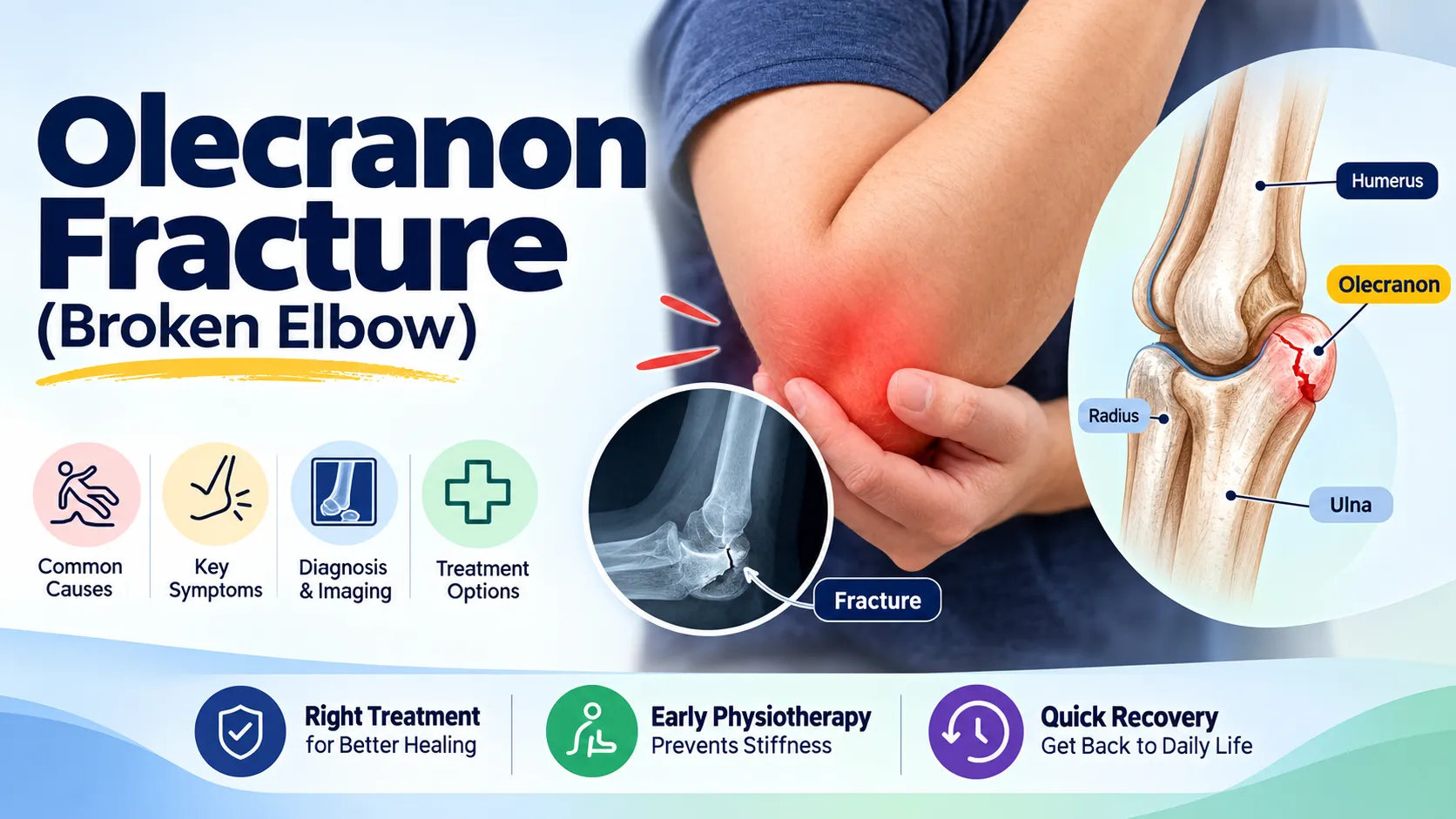
An olecranon fracture is a break in the bony tip of the elbow, the upper end of the ulna where the triceps tendon attaches. It usually results from a fall onto the elbow, a fall on an outstretched hand, or high-energy trauma such as road accidents. Symptoms include sudden pain at the back of the elbow, swelling, bruising, tenderness, and difficulty straightening the arm. Diagnosis is confirmed with elbow X-rays, and a CT scan is used for complex fractures. Non-displaced fractures heal with a splint or cast and early guided movement. Displaced fractures usually need surgery with tension band wiring or a locking plate, because the triceps pulls the fragments apart. Bone healing takes six to eight weeks, and full recovery takes three to six months. Early physiotherapy is essential to prevent stiffness, the most common complication.
An olecranon fracture is a break in the bony tip of the elbow, the point you can feel when you rest your arm on a table. Because this bone sits directly under the skin with very little padding, it breaks easily in falls and direct blows. It is one of the most common elbow fractures in adults. It also matters a lot for daily function, because the olecranon anchors the triceps muscle that straightens your arm.
Anatomy of the Elbow and Olecranon

The elbow is a hinge joint formed by three bones:
- Humerus, the upper arm bone
- Ulna, the forearm bone on the little-finger side
- Radius, the forearm bone on the thumb side
The olecranon is the curved, hook-shaped upper end of the ulna. It wraps around the lower end of the humerus and fits into a hollow called the olecranon fossa when the arm is straight. Together, the olecranon and the front part of the ulna form a deep socket called the trochlear notch, which gives the elbow its stability.
The triceps tendon attaches to the tip of the olecranon. When the triceps contracts, it pulls on the olecranon to straighten the elbow. This explains why a displaced olecranon fracture often leaves a patient unable to straighten the arm against gravity. The muscle keeps pulling the broken fragment away from the rest of the bone.
What is an Olecranon Fracture?
An olecranon fracture is any break in the olecranon process of the ulna. Because the fracture line almost always enters the elbow joint, it is classed as an intra-articular fracture. Restoring a smooth joint surface is essential to prevent long-term stiffness and arthritis.
Olecranon fractures vary widely in severity:
- A simple crack with the fragments still in place (non-displaced)
- A clean break with the pieces pulled apart (displaced)
- A shattered fracture with many small fragments (comminuted)
- A fracture with bone breaking through the skin (open or compound)
- A fracture combined with an elbow dislocation or other bone injuries (fracture-dislocation)
Causes of Olecranon Fractures
Most olecranon fractures result from one of three mechanisms:
- Direct blow to the back of the elbow, such as falling straight onto a bent elbow or striking it against a hard object
- Fall on an outstretched hand, where the elbow is slightly bent, and the triceps contracts strongly, pulling the olecranon apart
- High-energy trauma, including two-wheeler and road traffic accidents, falls from height, and industrial injuries
Risk factors include osteoporosis in older adults, contact sports, and work that carries a high risk of falls. In elderly patients, a simple slip at home can break an osteoporotic olecranon. Young adults typically need much greater force.
Symptoms of a Broken Elbow
Symptoms usually appear immediately after the injury:
- Sudden, intense pain at the back of the elbow
- Swelling and bruising around the elbow joint
- Tenderness when the olecranon is touched
- Inability to straighten the elbow fully, or weakness when trying
- A palpable gap or step at the tip of the elbow in displaced fractures
- Pain on moving the elbow or rotating the forearm
- Numbness or tingling in the ring and little fingers, which suggests irritation of the ulnar nerve
- An open wound with visible bone in compound fractures
Any of these symptoms after a fall or direct blow should lead to prompt orthopedic evaluation. Numbness in the hand, a cold or pale hand, or bone visible through the skin needs emergency care.
How an Olecranon Fracture Is Diagnosed
Clinical Examination
The doctor checks the skin for wounds, feels for tenderness and a gap at the elbow tip, and tests whether the patient can straighten the arm against gravity. Nerve function in the hand and blood supply to the fingers are checked carefully. The shoulder, forearm, and wrist are also examined, because associated injuries are common.
Imaging Tests
- X-rays of the elbow in front and side views are usually enough to confirm the fracture and show displacement
- CT scan is used for comminuted fractures, fracture-dislocations, or when the joint surface needs detailed mapping before surgery
- Comparison X-rays of the opposite elbow are sometimes taken in children, where growth plates can make interpretation difficult
Types and Classification of Olecranon Fractures
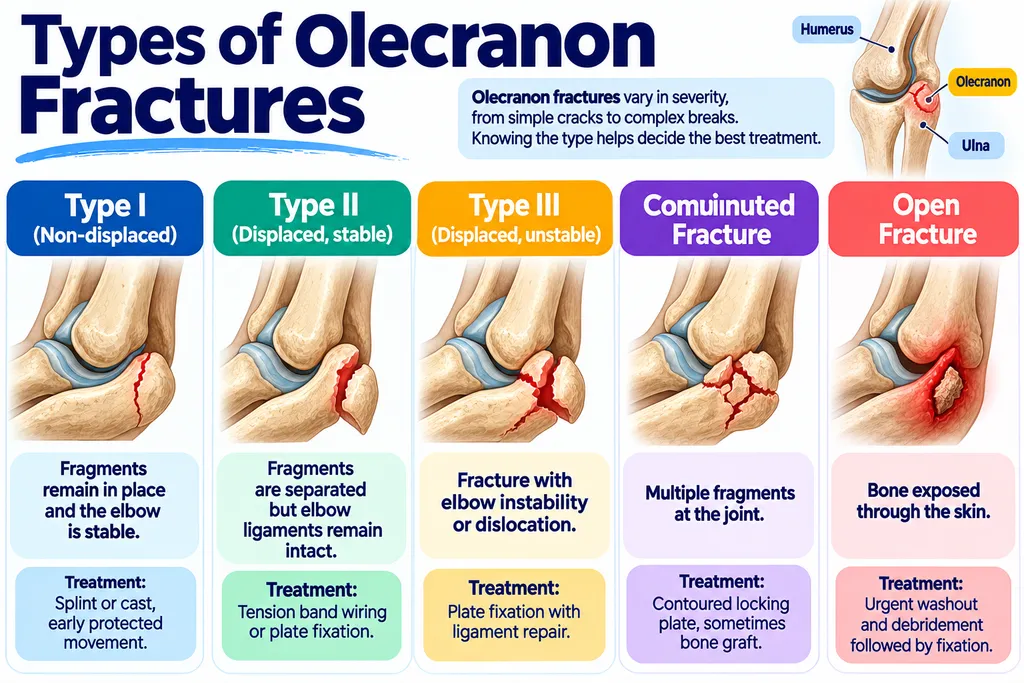
Orthopedic surgeons often use the Mayo classification, which groups olecranon fractures by displacement, comminution, and elbow stability. Treatment choice depends heavily on this assessment.
| Fracture Type | Description | Typical Treatment |
|---|---|---|
| Type I (non-displaced) | Fragments in place, elbow stable | Splint or cast, early protected movement |
| Type II (displaced, stable) | Fragments separated, elbow ligaments intact | Tension band wiring or plate fixation |
| Type III (displaced, unstable) | Fracture with elbow instability or dislocation | Plate fixation with ligament repair |
| Comminuted fracture | Multiple fragments at the joint | Contoured locking plate, sometimes bone graft |
| Open fracture | Bone exposed through skin | Urgent washout, then definitive fixation |
Treatment of Olecranon Fractures
The goals of treatment are to restore a smooth joint surface, rebuild triceps function, and start elbow movement as early as safely possible to prevent stiffness.
Nonsurgical Treatment
Nonsurgical care is suitable for:
- Non-displaced fractures where the patient can straighten the elbow against gravity
- Some elderly, low-demand patients with displaced fractures who are unfit for surgery
Treatment involves a long-arm splint or cast with the elbow bent at a comfortable angle, usually for two to three weeks. Gentle, protected range-of-motion exercises follow. Regular X-rays confirm that the fragments have not shifted. Many elderly patients achieve good functional results with this approach even with some residual displacement.
Surgical Treatment
Most displaced olecranon fractures need surgery, because the triceps continues to pull the fragments apart. Surgery is usually done within the first few days, once swelling allows.
Common surgical techniques include:
- Tension band wiring, in which two parallel wires and a figure-of-eight wire loop convert the pulling force of the triceps into compression at the fracture. It works well for simple transverse fractures
- Plate and screw fixation, using contoured locking plates shaped for the olecranon. It is the preferred option for comminuted, oblique, and unstable fractures, and for fracture-dislocations
- Olecranon hook plate, useful for small tip fractures where there is little bone to hold
- Intramedullary screw fixation for selected simple fractures
- Fragment excision with triceps advancement, an option in elderly patients with a small, shattered fragment that cannot be reliably fixed
Open Olecranon Fractures
Open fractures need urgent surgical washout and debridement to reduce the risk of deep infection, followed by stable fixation. When deep infection does develop around the bone or implants, specialised bone infection treatment is essential to control the infection and save elbow function.
Recovery and Rehabilitation After an Olecranon Fracture
Elbow joints stiffen quickly after injury, so rehabilitation starts early and is carefully structured.
- Phase 1 (0 to 2 weeks): Pain and swelling control, a splint or sling for comfort, and finger, wrist, and shoulder exercises to prevent stiffness in neighbouring joints.
- Phase 2 (2 to 6 weeks): Gentle active and assisted elbow bending and straightening under physiotherapy guidance. Lifting heavy objects and pushing up from a chair with the injured arm are avoided.
- Phase 3 (6 to 12 weeks): Progressive strengthening of the triceps, biceps, and forearm muscles once X-rays show healing. Normal daily activities resume gradually.
- Phase 4 (3 to 6 months): Return to heavier work, gym training, and sports, depending on the type of fracture and the job or sport.
Most patients regain good, functional elbow motion. A small loss of full straightening, often five to ten degrees, is common and rarely affects daily life.
Possible Complications
Olecranon fractures generally heal well, but some patients experience complications:
- Elbow stiffness, the most common problem, especially loss of full extension
- Painful or prominent hardware, because the olecranon has thin soft-tissue cover. Wires and plates are often removed after healing if they cause discomfort
- Wire migration after tension band wiring
- Ulnar nerve irritation causing tingling in the ring and little fingers
- Infection, particularly after open fractures
- Post-traumatic arthritis if the joint surface is not restored smoothly
- Delayed union or nonunion of a fracture, more likely in smokers, diabetics, and patients with poor bone quality or unstable fixation
- Heterotopic ossification, abnormal bone formation around the elbow that limits movement
Early recognition and treatment of these complications improve the final outcome considerably.
Olecranon Fractures in Children
Olecranon fractures are less common in children than in adults. In children, they are often associated with other elbow injuries, such as radial head or supracondylar fractures. Most non-displaced paediatric fractures heal with simple casting. Displaced fractures are fixed with wires or sutures that respect the growth plate. Children usually regain full movement faster than adults.
Why Choose Dr. Divya Ahuja for an Elbow Fracture
Dr. Divya Ahuja, MS Ortho, is a Mumbai-based orthopedic and Ilizarov surgeon with over 15 years of experience in orthopedic trauma and limb reconstruction. His practice at the Center for Limb Lengthening and Reconstruction, Mangal Anand Hospital, Chembur, manages:
- Acute olecranon and elbow fractures needing tension band wiring or plate fixation
- Comminuted and open elbow fractures with soft tissue injury
- Fracture-dislocations of the elbow
- Nonunion, malunion, and infected elbow fractures after previous surgery
- Post-traumatic elbow stiffness and hardware-related problems
He combines careful preoperative planning with structured rehabilitation so that patients regain the best possible elbow function. For a consultation with an experienced orthopedic surgeon in Mumbai, you can book online or visit the clinic at Chembur, Thane, Dadar, Vashi, Navi Mumbai, or Tilak Nagar.
Conclusion
An olecranon fracture may look like a simple broken elbow, but it affects a joint that must bend, straighten, and bear load thousands of times a day. Accurate diagnosis, the right choice between casting and surgery, stable fixation when needed, and early structured rehabilitation give the best long-term results. If you or a family member has injured an elbow, or you are dealing with stiffness, painful hardware, or a fracture that has not healed, consult Dr. Divya Ahuja for a detailed evaluation and an evidence-based treatment plan.
Frequently Asked Questions (FAQs)
What is an olecranon fracture?
An olecranon fracture is a break in the bony tip of the elbow, which is the upper end of the ulna bone. It usually happens after a fall onto the elbow or an outstretched hand and often involves the elbow joint surface.
How do I know if I have broken my elbow?
Common signs include sudden pain at the back of the elbow, swelling, bruising, tenderness at the elbow tip, and difficulty straightening the arm. A visible gap at the elbow tip or numbness in the fingers needs urgent orthopedic evaluation.
Can an olecranon fracture heal without surgery?
Yes, if the fracture is non-displaced and you can straighten your elbow against gravity. These fractures heal with a splint or cast and early guided movement. Displaced fractures usually need surgery because the triceps keeps pulling the fragments apart.
What surgery is done for an olecranon fracture?
The most common surgeries are tension band wiring for simple transverse fractures and locking plate fixation for comminuted, oblique, or unstable fractures. Hook plates, intramedullary screws, or fragment excision with triceps repair are used in selected cases.
How long does an olecranon fracture take to heal?
Bone healing usually takes six to eight weeks. Elbow movement improves over three months with physiotherapy, and full strength and return to heavy work or sport typically take three to six months, depending on fracture severity and treatment.
Will I get full movement back after an olecranon fracture?
Most patients regain good, functional elbow movement. A small loss of full straightening, often five to ten degrees, is common but rarely affects daily activities. Early, structured physiotherapy is the most important factor in preventing long-term stiffness.
Do the wires or plate need to be removed later?
Not always. Because the olecranon has very little soft tissue cover, implants can sometimes feel prominent or painful when leaning on the elbow. If that happens, they can be removed safely once the fracture has fully healed.
When can I start moving my elbow after surgery?
Gentle elbow movement usually begins within one to two weeks after stable surgical fixation, under physiotherapy guidance. Early motion prevents stiffness. Heavy lifting, pushing up with the arm, and strengthening exercises are delayed until X-rays show adequate healing.
What are the complications of an olecranon fracture?
Possible complications include elbow stiffness, painful hardware, wire migration, ulnar nerve irritation, infection, post-traumatic arthritis, nonunion, and abnormal bone formation around the joint. Most can be prevented or treated with careful surgery and structured rehabilitation.
Where can I get treatment for an elbow fracture in Mumbai?
Dr. Divya Ahuja treats olecranon and complex elbow fractures at the Center for Limb Lengthening and Reconstruction, Mangal Anand Hospital, Chembur. His work covers acute fixation, open fractures, nonunion, and post-traumatic elbow stiffness, with consultations across several Mumbai locations.