
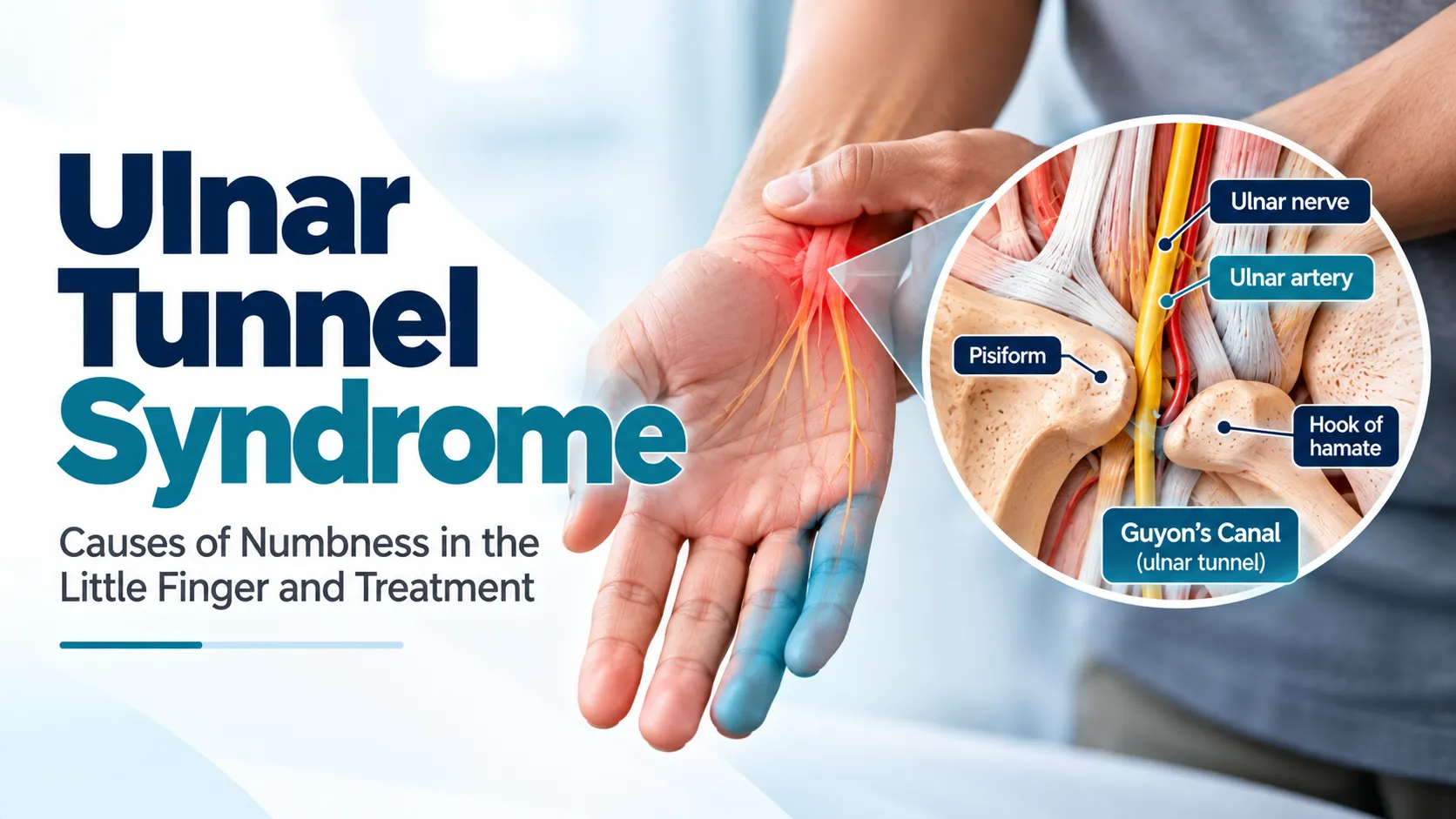
Quick Answer: Ulnar tunnel syndrome is a condition in which the ulnar nerve is compressed at the wrist as it passes through a narrow passage called Guyon’s canal. It causes numbness, tingling, or burning in the little finger and the outer half of the ring finger, along with weakness of the hand muscles, clumsiness, and difficulty gripping or spreading the fingers. The most common cause is a ganglion cyst. Other causes include repeated pressure on the palm from cycling or tools, a fracture of the hook of the hamate bone, and blood vessel problems. Diagnosis uses clinical examination, nerve conduction studies, and ultrasound or MRI to find the cause. Treatment includes avoiding pressure on the wrist, splinting, and anti-inflammatory medicines, while surgery is needed when a cyst, fracture, or growth compresses the nerve or weakness progresses.
Numbness or tingling in the little finger is a common complaint, and many people dismiss it as sleeping on the arm the wrong way. When it keeps coming back, or when the hand starts to feel weak and clumsy, it usually means the ulnar nerve is being squeezed somewhere along its path. When this compression happens at the wrist, the condition is called ulnar tunnel syndrome.
This article is written from the clinical perspective of Dr. Divya Ahuja at deformity.co.in, a Mumbai-based orthopedic and Ilizarov surgeon. It explains what ulnar tunnel syndrome is, how it differs from cubital tunnel and carpal tunnel syndromes, what causes it, and how it is treated.
What is Ulnar Tunnel Syndrome?
The ulnar nerve is one of the three main nerves of the arm. It runs from the neck, down the inner side of the arm, behind the elbow at the “funny bone,” and along the forearm into the hand. At the wrist, it passes through a small tunnel on the little-finger side called Guyon’s canal, or the ulnar tunnel.
Ulnar tunnel syndrome happens when the ulnar nerve is compressed inside Guyon’s canal. Because the tunnel is small and has firm walls, anything that takes up extra space, such as a cyst, swelling, or broken bone, can press on the nerve.
The condition is much less common than carpal tunnel syndrome, which affects the median nerve, and cubital tunnel syndrome, which affects the ulnar nerve at the elbow. Correctly identifying the site of compression is essential, because treatment depends on where the nerve is being squeezed.
Anatomy of the Ulnar Nerve and Guyon’s Canal

Guyon’s canal is formed between two small wrist bones, the pisiform and the hook of the hamate, and is covered by a ligament. The ulnar nerve travels through it together with the ulnar artery.
Inside the canal, the nerve divides into two branches:
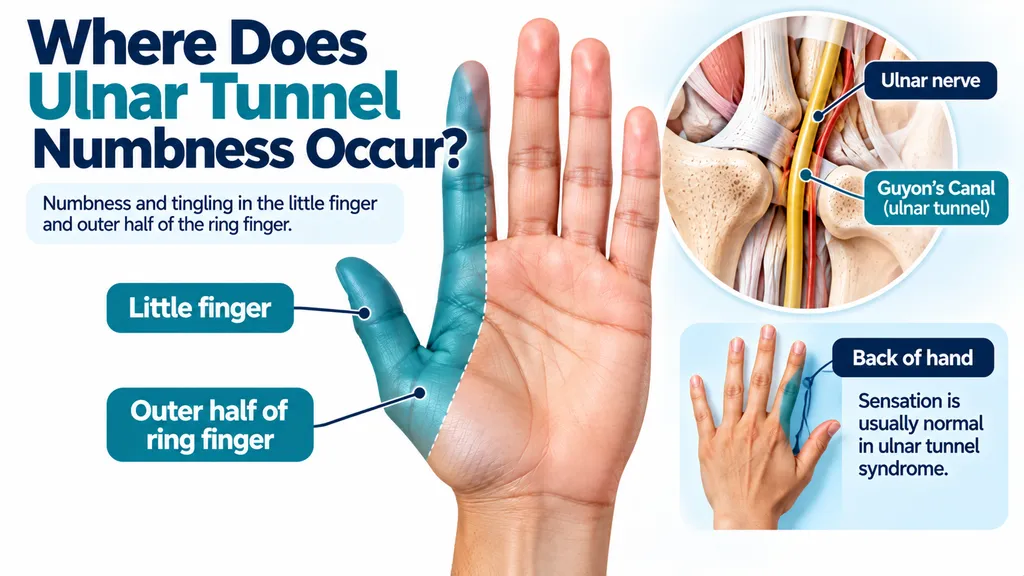
- A sensory branch, which supplies feeling to the little finger and the outer half of the ring finger
- A motor branch, which powers most of the small muscles of the hand that spread and close the fingers, help pinch with the thumb, and control fine movements
Depending on exactly where the nerve is compressed, a patient may have only numbness, only weakness, or both. This is why ulnar tunnel syndrome can look different from one person to another.
Causes of Ulnar Tunnel Syndrome
Common causes include:
- Ganglion cyst, a fluid-filled lump arising from a wrist joint. This is the most common cause
- Repeated pressure on the palm, from long-distance cycling, using tools such as hammers, pliers, or drills, pushing heavy carts, or leaning on the heel of the hand
- Fracture of the hook of the hamate, often after a fall or from gripping a bat, racquet, or golf club
- Wrist fractures and dislocations
- Ulnar artery problems, such as a blood clot or aneurysm, sometimes called hypothenar hammer syndrome in people who use the palm as a hammer
- Extra or enlarged muscles inside the canal
- Rheumatoid arthritis and other causes of wrist swelling
- Rarely, benign tumours such as lipomas
Diabetes, hypothyroidism, and alcohol use can make nerves more sensitive to compression and slow recovery.
Symptoms of Ulnar Tunnel Syndrome
Symptoms usually start gradually. Common symptoms include:
- Numbness or tingling in the little finger and the outer half of the ring finger
- Burning pain or aching in the hand, especially on the little-finger side
- Pain at the wrist on the pinky side
- Weakness of grip and pinch
- Clumsiness with fine tasks such as buttoning, writing, using a phone, or opening jars
- Difficulty spreading or closing the fingers
- Wasting of the muscles between the thumb and index finger or on the little-finger side of the palm
- In advanced cases, clawing of the ring and little fingers
How It Differs From Cubital Tunnel Syndrome
In ulnar tunnel syndrome, the back of the hand on the little-finger side usually keeps normal feeling. This is because the nerve branch to that area leaves the main nerve before reaching the wrist. In cubital tunnel syndrome at the elbow, the back of the hand is also numb, and symptoms are often worse when the elbow is bent for long periods.
Little Finger Numbness: When It Is an Emergency
Most little finger numbness is caused by nerve compression and is not dangerous. However, seek emergency medical care immediately if numbness in the arm or hand comes with:
- Chest pain, pressure, or discomfort
- Shortness of breath or sweating
- Sudden weakness of one side of the face or body
- Difficulty speaking or confusion
- Sudden loss of use of the hand or arm
These may be signs of a heart attack or stroke, which need urgent treatment.
Causes of Little Finger Numbness at a Glance
| Condition | Site of Problem | Key Features |
|---|---|---|
| Ulnar tunnel syndrome | Ulnar nerve at the wrist | Little and ring finger numbness, back of hand spared, hand weakness |
| Cubital tunnel syndrome | Ulnar nerve at the elbow | Numbness includes back of hand, worse with elbow bent |
| Carpal tunnel syndrome | Median nerve at the wrist | Numbness in thumb, index, and middle fingers |
| Cervical radiculopathy | Nerve root in the neck | Neck pain, arm pain, numbness along the arm |
| Peripheral neuropathy | Many nerves | Numbness in both hands and feet, common in diabetes |
| Thoracic outlet syndrome | Nerves near collarbone | Arm heaviness, symptoms with overhead activity |
How Ulnar Tunnel Syndrome Is Diagnosed
Medical History and Examination
The doctor asks about your symptoms, work, hobbies such as cycling or tool use, injuries, and medical conditions. The examination checks:
- Which areas of the hand are numb
- Strength of grip, pinch, and finger spreading
- Muscle wasting in the hand
- Tinel’s sign, tapping over Guyon’s canal to see if it causes tingling
- Froment’s sign, which shows weakness of the pinch muscles
- The elbow and neck, to rule out compression higher up
- Blood flow in the ulnar artery
Tests
- Nerve conduction studies and EMG confirm ulnar nerve compression, show where it is, and measure how severe it is
- X-rays, including a special carpal tunnel view, can reveal a hook of hamate fracture
- CT scan gives more detail when a fracture is suspected
- Ultrasound or MRI can show a ganglion cyst, tumour, or other mass in the canal
- Doppler ultrasound checks the ulnar artery when a blood vessel problem is suspected
Treatment of Ulnar Tunnel Syndrome
Treatment depends on the cause. When a structure such as a cyst or fracture is pressing on the nerve, removing or treating it is usually needed. When pressure or overuse is the cause, simple measures often work.
Nonsurgical Treatment
- Avoid pressure on the wrist and palm. Change grip habits, take breaks, and avoid leaning on the heel of the hand
- Padded cycling gloves and changing handlebar position for cyclists
- Padded tool handles and anti-vibration gloves for workers
- Wrist splint, especially at night, to keep the wrist in a neutral position
- Anti-inflammatory medicines for short-term pain relief
- Nerve gliding exercises taught by a physiotherapist or hand therapist
- Ergonomic changes at work, such as keyboard and mouse position
Mild cases caused by repeated pressure often improve within weeks to a few months.
Surgical Treatment
Surgery is advised when:
- A ganglion cyst, tumour, or other mass is compressing the nerve
- A hook of hamate fracture is pressing on the nerve or fails to heal
- There is muscle weakness or wasting
- Symptoms do not improve with nonsurgical care
The operation, called Guyon’s canal release or ulnar tunnel release, is usually done as a day-care procedure. A small incision is made on the palm near the wrist, the roof of the tunnel is opened, and any cyst, bone fragment, or other compressing structure is removed. A hook of hamate fracture may be removed if it is causing symptoms. Surgery of this kind is typically performed by a hand and upper limb surgeon.
Recovery After Surgery
- Stitches are removed in about 10 to 14 days
- Light hand use usually starts within a few days
- Numbness and tingling often improve over weeks to months
- Muscle strength may take several months to return, because nerves recover slowly
- Long-standing compression with muscle wasting may not recover completely
This is why early diagnosis and treatment matter.
Preventing Ulnar Tunnel Syndrome
- Avoid long periods of direct pressure on the heel of the hand
- Use padded gloves when cycling, lifting weights, or using vibrating tools
- Change hand position often during repetitive work
- Do not use the palm as a hammer
- Keep the wrist straight while typing and using a mouse
- Take regular breaks from gripping tasks
- Control diabetes and thyroid conditions, which affect nerve health
- Get a persistent wrist lump or old wrist injury checked early
When to See an Orthopedic Surgeon
Consult an orthopedic surgeon if you have:
- Numbness or tingling in the little and ring fingers lasting more than a few weeks
- Weakness, clumsiness, or difficulty gripping
- Visible thinning of the hand muscles
- A lump on the pinky side of the wrist
- Pain or numbness after a fall or wrist injury
- Symptoms that disturb sleep or work
Dr. Divya Ahuja, MS Ortho, is a Mumbai-based orthopedic and Ilizarov surgeon with over 15 years of experience in musculoskeletal and trauma care. His practice at the Center for Limb Lengthening and Reconstruction, Mangal Anand Hospital, Chembur, evaluates little finger numbness and wrist nerve symptoms, arranges nerve studies and imaging, starts conservative treatment, manages related wrist injuries, and refers patients to a hand surgery specialist when nerve release is needed. For a consultation with an experienced orthopedic surgeon in Mumbai, you can book online or visit the clinic at Chembur, Thane, Dadar, Vashi, Navi Mumbai, or Tilak Nagar.
Conclusion
Ulnar tunnel syndrome is an uncommon but important cause of little finger numbness and hand weakness. Finding the exact site and cause of nerve compression is the key to effective treatment. Many cases improve when pressure on the wrist is removed, while cysts, fractures, and progressive weakness need timely surgery. If your little or ring finger has been numb, tingly, or weak for more than a few weeks, consult Dr. Divya Ahuja for a clear diagnosis and the right treatment plan.
Frequently Asked Questions (FAQs)
What is ulnar tunnel syndrome?
Ulnar tunnel syndrome is compression of the ulnar nerve at the wrist as it passes through Guyon’s canal. It causes numbness and tingling in the little and ring fingers, weakness of hand muscles, and difficulty with grip and fine movements.
Why is my little finger numb?
Little finger numbness usually comes from pressure on the ulnar nerve at the elbow or wrist. Other causes include a pinched nerve in the neck, diabetes-related nerve damage, or an injury. Persistent numbness should be checked by an orthopedic doctor.
What causes ulnar tunnel syndrome?
The most common cause is a ganglion cyst at the wrist. Others include repeated pressure on the palm from cycling or tools, a hook of hamate fracture, wrist injuries, ulnar artery problems, extra muscles in the canal, and arthritis-related swelling.
How is ulnar tunnel syndrome different from cubital tunnel syndrome?
Both affect the ulnar nerve. Ulnar tunnel syndrome is compression at the wrist, and the back of the hand usually keeps normal feeling. Cubital tunnel syndrome is compression at the elbow, often worse with bent elbows, and may numb the back of the hand.
Is little finger numbness a sign of a heart attack?
Usually not. Most little finger numbness is caused by nerve compression. However, sudden arm or hand numbness with chest pain, breathlessness, sweating, or face weakness may signal a heart attack or stroke and needs emergency medical care immediately.
How is ulnar tunnel syndrome diagnosed?
Diagnosis combines a hand examination with nerve conduction studies and EMG to confirm nerve compression. X-rays or CT scans look for a hamate fracture, while ultrasound or MRI can reveal a ganglion cyst or other mass inside Guyon’s canal.
Can ulnar tunnel syndrome be treated without surgery?
Yes, when it is caused by repeated pressure or overuse. Avoiding pressure on the palm, padded gloves, a wrist splint, anti-inflammatory medicines, and nerve gliding exercises often help. Cysts, fractures, or muscle weakness usually require surgical treatment.
When is surgery needed for ulnar tunnel syndrome?
Surgery is needed when a cyst, fracture, or other mass compresses the nerve, when hand muscles become weak or wasted, or when symptoms do not improve with nonsurgical care. The procedure, called Guyon’s canal release, is usually a day-care surgery.
How long does recovery take after ulnar tunnel release?
Stitches are removed in about 10 to 14 days, and light hand use starts within days. Numbness improves over weeks to months, while strength may take several months. Long-standing compression with muscle wasting may not recover fully.
Which doctor should I see for little finger numbness?
An orthopedic surgeon can evaluate little finger numbness, arrange nerve studies and imaging, and start treatment. When surgical nerve release is required, patients are often referred to a hand and upper limb surgeon. Sudden numbness with chest pain needs emergency care.