

Quick Answer: Patellofemoral pain syndrome (PFPS), often called runner’s knee, is pain at the front of the knee around or behind the kneecap (patella). It happens when the patellofemoral joint, where the kneecap glides over the thigh bone, is overloaded. Common causes include overuse in running and jumping sports, weak thigh and hip muscles, tight leg muscles, flat feet, and poor kneecap tracking, sometimes linked to knock knees or other limb malalignment. Symptoms include a dull ache around the kneecap that worsens with stairs, squatting, kneeling, and sitting with bent knees for long periods. Diagnosis is clinical, with X-rays or MRI in selected cases. Most patients recover in six to twelve weeks with activity changes, ice, physiotherapy focused on quadriceps and hip strengthening, taping or bracing, and proper footwear. Surgery is rarely needed.
Patellofemoral pain syndrome, or PFPS, is one of the most common causes of knee pain seen in orthopedic clinics. It affects runners, cyclists, footballers, dancers, gym-goers, and also people who simply climb a lot of stairs or sit for long hours with their knees bent. Because it is so common among athletes, it is widely known as runner’s knee.
This article is written from the clinical perspective of Dr. Divya Ahuja at deformity.co.in, a Mumbai-based orthopedic and Ilizarov surgeon specialising in limb alignment and deformity correction. It explains what PFPS is, why it develops, how it differs from chondromalacia patella and kneecap maltracking, and how it is treated.
What Is Patellofemoral Pain Syndrome?
The patellofemoral joint is where the back of the kneecap (patella) meets a groove at the lower end of the thigh bone (femur). This groove is called the trochlear groove. Every time you bend or straighten your knee, the kneecap glides up and down within it.
Patellofemoral pain syndrome is pain arising from this joint and the soft tissues around it. It usually develops when the joint is repeatedly overloaded, or when the kneecap does not glide smoothly in its groove. The pain is felt around, behind, above, or just below the kneecap.
PFPS is not a single injury. It is an overload condition. In most patients, X-rays and scans look normal, and the problem lies in how forces pass through the joint rather than in visible damage.
Anatomy of the Kneecap and Patellofemoral Joint
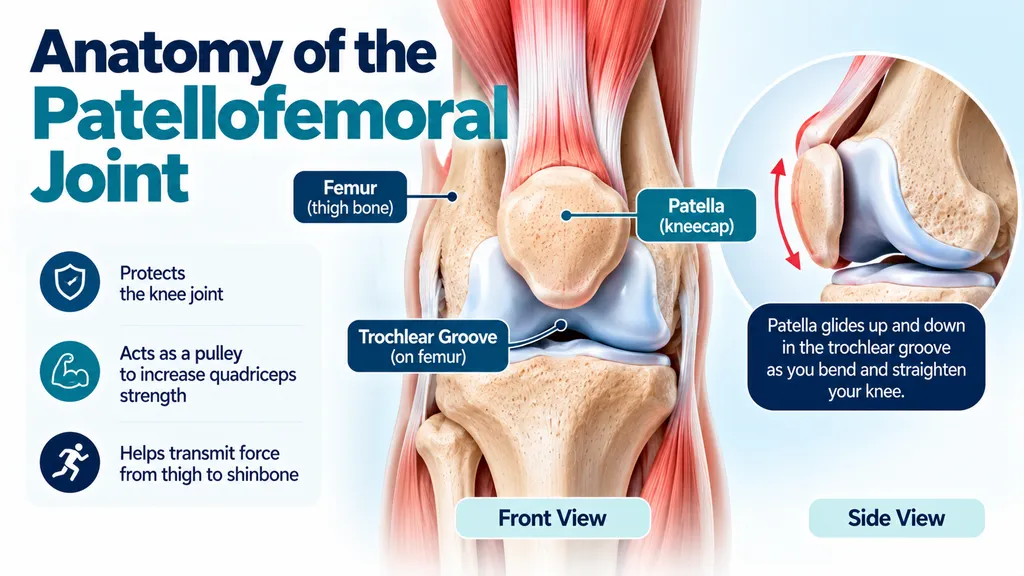
The patella is a triangular bone that sits inside the tendon of the quadriceps, the large muscle group at the front of the thigh. Its main jobs are to:
- Protect the front of the knee joint
- Act as a pulley that increases the strength of the quadriceps
- Transmit force from the thigh muscles to the shinbone through the patellar tendon
The underside of the patella is covered with thick, smooth articular cartilage, which allows it to glide with very little friction. During everyday activities, the force across this joint can be several times your body weight. Squatting, kneeling, jumping, and climbing stairs raise these forces even further.
Soft tissues that keep the kneecap centred include the vastus medialis obliquus (VMO) muscle on the inner thigh, the lateral retinaculum on the outer side, the medial patellofemoral ligament, and the iliotibial band (IT band). An imbalance between these structures can pull the kneecap off its ideal path.
Causes of Patellofemoral Pain Syndrome
Overuse and Training Errors
The most common cause is repetitive stress, such as:
- Sudden increase in running distance, speed, or training days
- Frequent jumping, squatting, or lunging
- Running downhill or on hard, uneven surfaces
- Long stair climbing, trekking, or heavy gym leg sessions
Muscle Weakness and Imbalance
- Weak quadriceps, especially the VMO
- Weak hip abductor and gluteal muscles, which let the knee collapse inward during movement
- Weak core muscles affecting overall leg control
Tight Soft Tissues
- Tight hamstrings, calves, and quadriceps
- Tight IT band and lateral retinaculum, which pull the kneecap outward
Kneecap Tracking Problems
Patellar maltracking means the kneecap shifts or tilts out of its groove as the knee moves. It can result from muscle imbalance, a shallow trochlear groove, or a high-riding patella (patella alta).
Lower-Limb Alignment
The alignment of the whole leg affects the kneecap. Knock knees increase the outward pull on the kneecap, while bow legs and rotational twists of the thigh or shinbone change how load passes through the joint. Flat feet and overpronation can also rotate the leg inward and stress the kneecap.
Other Factors
- Excess body weight
- Previous knee injury or surgery
- Female sex, due to wider pelvis and greater knee angle
- Poor footwear
Symptoms of Patellofemoral Pain Syndrome
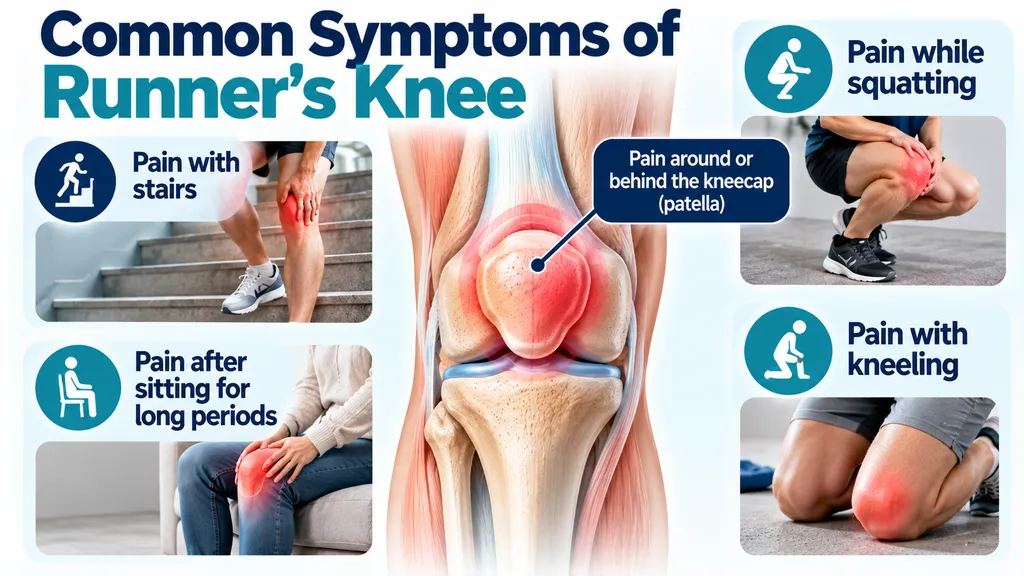
The main symptom is a dull, aching pain at the front of the knee. Other common symptoms include:
- Pain around, behind, above, or just below the kneecap
- Pain when climbing or going down stairs
- Pain while squatting, kneeling, lunging, or jumping
- Pain after sitting for a long time with bent knees, sometimes called the “movie-goer’s sign” or “theatre sign”
- Pain after sleeping with the legs bent
- Grinding, clicking, or cracking sounds when bending the knee
- Mild swelling after activity
- A feeling that the knee may give way, though true locking is uncommon
Symptoms often involve both knees and tend to come and go with activity levels.
PFPS vs Chondromalacia Patella vs Patellar Maltracking
These terms are often used interchangeably, but they mean different things.
| Term | What It Means | Key Features |
|---|---|---|
| Patellofemoral pain syndrome | Pain from overload of the kneecap joint | Front knee pain, imaging usually normal |
| Chondromalacia patella | Softening or wear of cartilage under the kneecap | Grinding, pain on pressure, cartilage changes on MRI |
| Patellar maltracking | Kneecap shifts or tilts out of its groove | Kneecap moves abnormally, may lead to instability |
| Patellar instability | Kneecap partly or fully dislocates | Episodes of kneecap slipping out, swelling |
| Patellar tendinitis | Irritation of tendon below the kneecap | Pain at lower tip of kneecap, jumping sports |
Long-standing PFPS and maltracking can lead to chondromalacia patella if the cartilage is repeatedly overloaded.
How Patellofemoral Pain Syndrome Is Diagnosed
Medical History
The doctor asks about your sports and training habits, recent changes in activity, which movements cause pain, and any past injuries.
Physical Examination
The examination may include:
- Observing how you stand, walk, squat, and step down from a step
- Checking leg alignment, kneecap position, and foot posture
- Pressing around the kneecap to find tender areas
- Watching how the kneecap tracks as the knee bends and straightens
- Testing strength of the quadriceps, hip, and core muscles
- Checking flexibility of the hamstrings, calves, quadriceps, and IT band
Special tests such as the patellar grind test (Clarke’s test) and the patellar apprehension test help assess kneecap pain and stability. These tests must be interpreted together with the full clinical picture.
Imaging Tests
Most patients do not need scans. Imaging is used when symptoms persist or another problem is suspected:
- X-rays, including a skyline view of the kneecap, show kneecap position, tilt, and bony problems
- Full-length standing X-rays assess leg alignment when knock knees, bow legs, or limb length difference are suspected
- MRI scan shows cartilage damage, bone bruising, and soft tissue injury
- CT scan may be used to measure rotational alignment of the thigh and shin bones
Treatment of Patellofemoral Pain Syndrome
Treatment aims to reduce stress on the kneecap, correct the underlying cause, and return you safely to your activities. Most patients improve without surgery.
Activity Modification
- Reduce or pause running, jumping, deep squats, and kneeling for a few weeks
- Switch to low-impact exercise such as swimming or cycling with the seat raised
- Avoid sitting with bent knees for long periods, and stretch your legs often
- Return to sport gradually once pain is under control
Ice and Medicines
- Apply ice packs for 15 to 20 minutes after activity
- Short courses of anti-inflammatory medicines may help ease pain under medical advice
Physiotherapy and Exercises
Physiotherapy is the cornerstone of PFPS treatment. A typical programme includes:
- Quadriceps strengthening, such as straight leg raises, short-arc knee extensions, and wall sits in a pain-free range
- Hip strengthening, such as clamshells, side-lying leg raises, glute bridges, and band walks
- Core stability exercises
- Stretching of the hamstrings, calves, quadriceps, and IT band
- Balance and movement retraining to stop the knee collapsing inward during squats, landings, and running
- Running form correction, such as shorter strides and a higher step rate
Many patients notice improvement within four to six weeks, with substantial recovery in six to twelve weeks.
Taping and Knee Braces
- Patellar taping can reduce pain during exercise and help muscle retraining
- Patellofemoral knee braces or patella support sleeves with a cut-out around the kneecap offer comfort for some patients
These are short-term aids that support exercise, not a replacement for it.
Footwear and Orthotics
Supportive shoes suited to your foot type and activity help reduce stress on the knee. Arch supports or custom orthotics are useful for patients with flat feet or overpronation.
Weight Management
Every extra kilogram of body weight adds load to the patellofemoral joint. Gradual weight loss can make a meaningful difference to knee pain.
When Is Surgery Needed?
Surgery is rarely needed for patellofemoral pain syndrome. It is considered only when symptoms persist for six to twelve months despite a well-structured rehabilitation programme, and when there is a clear structural problem.
Surgical options may include:
- Arthroscopy to treat damaged cartilage or remove loose pieces
- Lateral retinacular lengthening for a tight outer soft tissue pulling the kneecap outward
- Medial patellofemoral ligament (MPFL) reconstruction for recurrent kneecap dislocation
- Tibial tubercle realignment to improve kneecap tracking
- Correction of limb malalignment, such as guided growth in children or corrective osteotomy in adults with significant knock knees, bow legs, or rotational deformity
Careful assessment is essential before surgery, because operating on a knee with simple PFPS and no structural cause rarely helps.
How to Prevent Runner’s Knee
- Increase training load gradually, by no more than about 10 percent per week
- Warm up before sport and stretch after exercise
- Strengthen your thighs, hips, and core regularly
- Use proper technique for squats, lunges, and landings
- Wear supportive shoes and replace worn-out running shoes
- Maintain a healthy body weight
- Avoid long periods of sitting with your knees bent
- Address persistent knee pain early instead of training through it
When to See an Orthopedic Surgeon
Consult an orthopedic surgeon if:
- Front knee pain lasts more than six to eight weeks despite rest and exercises
- The kneecap feels unstable, slips, or dislocates
- There is significant swelling, locking, or difficulty bearing weight
- Pain started after an injury or fall
- You notice knock knees, bow legs, or a leg length difference
- Knee pain affects your sleep, sport, or work
Dr. Divya Ahuja, MS Ortho, is a Mumbai-based orthopedic and Ilizarov surgeon with over 15 years of experience in limb alignment, deformity correction, and complex orthopedic care. His practice at the Center for Limb Lengthening and Reconstruction, Mangal Anand Hospital, Chembur, evaluates persistent front knee pain, measures limb alignment with full-length X-rays and software-assisted planning, and offers corrective surgery when knock knees, bow legs, or rotational deformity drive kneecap overload. For a consultation with an experienced orthopedic surgeon in Mumbai, you can book online or visit the clinic at Chembur, Thane, Dadar, Vashi, Navi Mumbai, or Tilak Nagar.
Conclusion
Patellofemoral pain syndrome is a common and very treatable cause of front knee pain. In most people, a combination of smart activity changes, focused strengthening, flexibility work, and good footwear brings lasting relief without surgery. When pain persists, the kneecap feels unstable, or the leg alignment looks abnormal, a detailed orthopedic evaluation can find the root cause. Consult Dr. Divya Ahuja for an accurate diagnosis of your knee pain and a personalised, evidence-based treatment plan.
Frequently Asked Questions (FAQs)
What is patellofemoral pain syndrome?
Patellofemoral pain syndrome is pain at the front of the knee, around or behind the kneecap. It occurs when the joint between the kneecap and thigh bone is overloaded, usually through running, jumping, squatting, stairs, or poor kneecap tracking.
What does PFPS mean?
PFPS stands for patellofemoral pain syndrome. It describes front knee pain arising from the patellofemoral joint, where the kneecap glides over the thigh bone. It is also commonly called runner’s knee because it often affects runners and athletes.
What causes patellofemoral pain syndrome?
Common causes include overuse, sudden training increases, weak quadriceps and hip muscles, tight hamstrings and IT band, flat feet, kneecap maltracking, excess body weight, and limb malalignment such as knock knees, bow legs, or rotational deformity of the leg.
What are the symptoms of patellofemoral pain syndrome?
The main symptom is a dull ache around or behind the kneecap. Pain worsens with stairs, squatting, kneeling, jumping, and sitting with bent knees for long periods. Some patients notice grinding or clicking and mild swelling after activity.
Is patellofemoral pain syndrome the same as chondromalacia patella?
No. PFPS is pain from overload of the kneecap joint, and imaging is often normal. Chondromalacia patella means actual softening or wear of the cartilage under the kneecap, seen on MRI. Long-standing PFPS may sometimes lead to chondromalacia.
What are the best exercises for patellofemoral pain syndrome?
Effective exercises include straight leg raises, wall sits within a pain-free range, glute bridges, clamshells, side-lying leg raises, and hamstring, calf, and IT band stretches. A physiotherapist can tailor and progress the programme safely for your knee.
How long does patellofemoral pain syndrome take to heal?
Most patients improve within four to six weeks of activity changes and physiotherapy, with substantial recovery in six to twelve weeks. Long-standing cases or those linked to malalignment may take longer and need a more detailed assessment.
Does a knee brace help patellofemoral pain?
A patellofemoral brace or kneecap support sleeve can reduce pain and improve comfort during activity for some patients. Braces and taping work best alongside strengthening exercises and should not be used as the only treatment.
Can I keep running with runner’s knee?
It is usually better to reduce or pause running until pain settles, using swimming or cycling to stay fit. Once strength improves, running can resume gradually with shorter distances, softer surfaces, and good form. Running through pain often slows recovery.
When does patellofemoral pain syndrome need surgery?
Surgery is rarely needed. It is considered only when pain persists for six to twelve months despite proper rehabilitation and a structural cause is found, such as recurrent kneecap dislocation, cartilage damage, or significant knock knees, bow legs, or rotational deformity.