
Calcium for Bone Health is the main mineral that gives bones their strength, with about 99 percent of the body’s calcium stored in the skeleton. Most adults aged 19 to 50 need 1,000 mg of calcium daily, while teenagers, women over 50, and adults over 70 need 1,200 to 1,300 mg. Rich Indian sources include milk, curd, paneer, ragi, sesame seeds, almonds, drumstick leaves, and small bony fish. Vitamin D is equally important because it helps the intestines absorb calcium, so both nutrients work together to build strong bones, prevent osteoporosis, and support fracture healing.
Why Calcium Matters for Your Bones
Calcium is the most abundant mineral in the body, and about 99 percent of it is stored in your bones and teeth. The remaining one percent circulates in the blood, where it is essential for muscle contraction, nerve signalling, blood clotting, and a normal heartbeat.
The body will not tolerate low blood calcium, so when your diet does not supply enough, calcium is pulled out of your bones to keep the blood level steady. Over years, this steady withdrawal weakens the bone structure and leads to osteopenia and then osteoporosis, a condition where bones become fragile and break easily. This is why women after menopause, older men, teenagers in their growth phase, and pregnant or breastfeeding women all have higher calcium requirements. Building strong bones early and maintaining them lifelong is the single best defence against fragility fractures later on.
Daily Calcium Requirements by Age
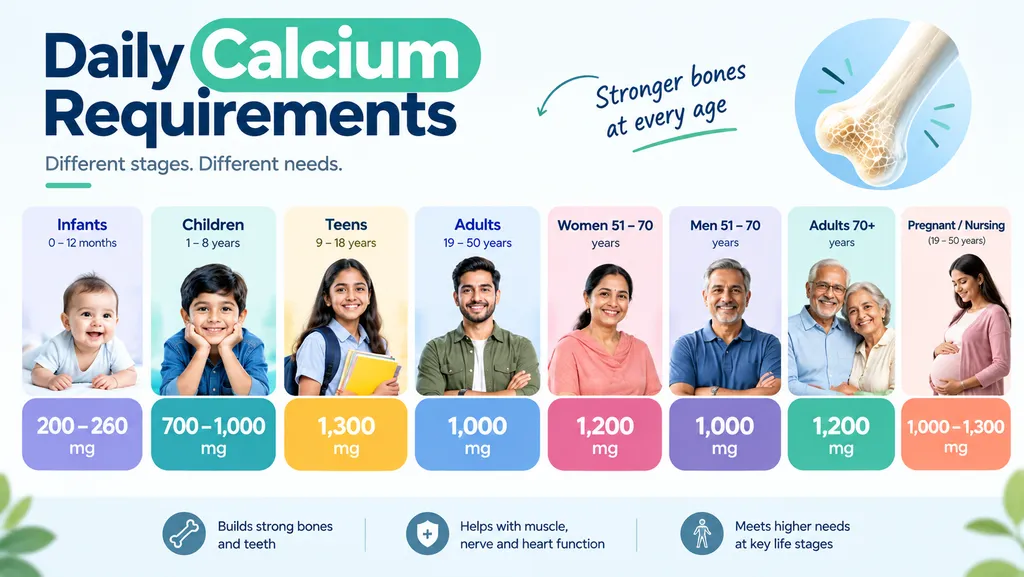
Calcium needs change through life. The following amounts are widely recommended targets:
| Life Stage | Daily Calcium Requirement |
|---|---|
| Infants 0 to 6 months | 200 mg |
| Infants 7 to 12 months | 260 mg |
| Children 1 to 3 years | 700 mg |
| Children 4 to 8 years | 1,000 mg |
| Teens 9 to 18 years | 1,300 mg |
| Adults 19 to 50 years | 1,000 mg |
| Women 51 to 70 years | 1,200 mg |
| Men 51 to 70 years | 1,000 mg |
| Adults over 70 years | 1,200 mg |
| Pregnant or nursing women (19 to 50) | 1,000 mg |
| Pregnant or nursing teens | 1,300 mg |
Best Food Sources of Calcium
The body absorbs calcium best when it comes from food. A well-planned Indian diet can meet most of your daily needs without supplements.
Dairy Sources
Dairy is the richest source of calcium in most Indian diets:
- Milk: 1 glass (250 ml) gives about 300 mg
- Curd (dahi): 1 cup gives about 300 mg
- Paneer: 100 grams gives about 200 mg
- Cheese: 30 grams gives about 200 mg
- Buttermilk (chaas): 1 glass gives about 100 mg
Non-Dairy Sources
Non-vegetarian, vegan, and lactose-intolerant patients have plenty of alternatives:
- Ragi (finger millet): 100 grams gives about 350 mg
- Sesame seeds (til): 1 tablespoon gives about 90 mg
- Almonds: 30 grams gives about 75 mg
- Drumstick leaves and moringa: very calcium-rich
- Amaranth (rajgira), spinach, and other leafy greens
- Tofu made with calcium sulphate: 100 grams gives about 250 mg
- Small fish eaten with bones such as sardines and rohu fry
- Rajma, chana, black-eyed peas, and other pulses
- Calcium-fortified soy milk and orange juice
Sodas, excess tea and coffee, and very high salt intake reduce calcium retention in the body and should be minimised.
When to Consider Calcium Supplements
Food comes first, but supplements are often needed in specific situations:
- Postmenopausal women, especially after 50 years of age
- Men over 70
- Lactose-intolerant or vegan individuals who cannot easily meet targets
- Adolescents with poor dietary intake
- Pregnant and breastfeeding mothers
- Patients on long-term steroids, anti-epileptic drugs, or proton pump inhibitors
- Anyone diagnosed with osteopenia, osteoporosis, or a fragility fracture
- Patients recovering from a major fracture or orthopedic surgery
A few practical points about supplements:
- Absorption is best in doses of 500 mg or less at a time. If you need 1,000 mg per day, split it into two doses.
- Calcium citrate is absorbed even without food and is a good option for older adults or patients on antacids.
- Calcium carbonate is cheaper but needs stomach acid, so take it with meals.
- Most calcium supplements are combined with vitamin D, which helps absorption.
Never self-prescribe long-term high-dose calcium. Excess intake can raise the risk of kidney stones and, in some studies, cardiovascular problems.
Vitamin D: The Partner Nutrient
Without enough vitamin D, even a calcium-rich diet does not help, because your intestines cannot absorb the calcium efficiently. In children, severe vitamin D deficiency causes rickets, with bowed legs and other skeletal deformities. In adults, it causes osteomalacia, a condition of soft, painful bones that fracture easily.
Vitamin D Requirements
- Infants: 400 IU per day
- Children and adults from age 1 to 70: 600 to 800 IU per day
- Adults over 70: 800 to 1,000 IU per day
- Many experts now recommend at least 1,000 IU per day for good bone health from around age 5 onwards
Vitamin D Sources
- Sunlight is the biggest source, with about 15 to 20 minutes of direct arm and face exposure between 10 am and 3 pm several days a week
- Fatty fish such as salmon, mackerel, and sardines
- Egg yolks
- Fortified milk, cereals, and juices
- Cod liver oil and vitamin D supplements
Vitamin D Deficiency in India
Despite abundant sunshine, vitamin D deficiency is extremely common in India. Reasons include mostly indoor lifestyles, air pollution reducing UVB exposure, darker skin needing more sunlight to make the same amount of vitamin D, use of sunscreen and full-cover clothing, and low intake of fortified foods. Testing and correction is often needed under medical guidance.
Other Nutrients That Support Bone Health
Calcium and vitamin D do not work alone. Several other nutrients play supporting roles:
- Protein provides the collagen scaffold of bone. Aim for pulses, dals, eggs, fish, chicken, and dairy across the day
- Phosphorus is the second major bone mineral, present in dairy, eggs, fish, and beans
- Magnesium improves bone crystal quality and is found in nuts, seeds, whole grains, bananas, and green leafy vegetables
- Vitamin K helps deposit calcium into bone rather than blood vessels, and is available in leafy greens, cabbage, and broccoli
- Vitamin C is essential for collagen synthesis, from citrus fruits, guava, amla, tomato, and bell peppers
- Vitamin A supports normal bone cell activity, but only in balanced amounts, from carrots, papaya, spinach, and eggs
- Zinc aids bone formation and is present in pulses, seeds, and lean meat
A varied Indian thali of dals, subzi, curd, roti, seasonal fruits, and small amounts of dairy or fish generally covers all of these.
Foods and Habits That Weaken Bones
Some everyday habits quietly work against your bone health:
- Heavy consumption of soda and cola drinks, which promote calcium loss
- Excess salt intake through papad, pickles, and packaged foods
- More than three to four cups of strong tea or coffee per day
- Smoking and tobacco chewing, which impair bone-building cells
- Regular alcohol intake beyond moderate limits
- Crash diets and prolonged calorie restriction
- Sedentary lifestyle with no weight-bearing activity
- Long-term use of certain medications without bone protection
Small changes in these areas, sustained over years, translate into measurable gains in bone strength.
Calcium, Vitamin D, and Fracture Healing

For any patient recovering from a fracture, joint surgery, or reconstructive procedure, bone nutrition is not optional. Bone healing is a demanding process that needs calcium, vitamin D, protein, and micronutrients in adequate supply throughout the several months of union and remodelling. Deficiencies slow the formation of callus, increase the risk of delayed healing, and can contribute to failure of union or hardware.
In complex fracture treatment, especially in older patients or those with previous fragility fractures, correction of calcium and vitamin D deficiency is a standard part of the pre-operative and post-operative plan. In patients with nonunion of a fracture, where the bone has failed to unite despite adequate fixation, nutritional deficiencies, metabolic bone disease, smoking, and diabetes are systematically checked and corrected as part of the reconstruction plan. Optimising bone nutrition does not replace good surgery, but it gives every operation the best possible chance of success.
Safe Upper Limits of Calcium and Vitamin D
More is not better. The following are widely accepted safe upper limits per day:
| Age Group | Calcium Upper Limit | Vitamin D Upper Limit |
|---|---|---|
| Children 1 to 8 years | 2,500 mg | 2,500 to 3,000 IU |
| Children 9 to 18 years | 3,000 mg | 4,000 IU |
| Adults 19 to 50 years | 2,500 mg | 4,000 IU |
| Adults over 50 years | 2,000 mg | 4,000 IU |
Excess calcium can cause kidney stones and constipation, and very high vitamin D levels can lead to hypercalcemia and kidney damage. Always talk to your doctor before starting high-dose supplements or combining multiple bone products.
When to See an Orthopedic Surgeon
You should consult an orthopedic surgeon if you have suffered a low-trauma fracture (a break from a simple fall or minor knock), a family history of hip fracture, a diagnosis of osteopenia or osteoporosis, long-term steroid use, loss of height with a hunched posture, or persistent bone or muscle pain of unclear origin.
Dr. Divya Ahuja, MS Ortho, is a Mumbai-based orthopedic and Ilizarov surgeon with over 15 years of experience in fracture care, deformity correction, and limb reconstruction at the Center for Limb Lengthening and Reconstruction, Mangal Anand Hospital, Chembur. His practice regularly assesses bone quality, orders relevant blood tests and DEXA scans, and integrates nutritional and metabolic optimisation into every surgical plan. For a bone health evaluation with an experienced orthopedic surgeon in Mumbai, you can book online or visit the clinic across Chembur, Thane, Dadar, Vashi, Navi Mumbai, or Tilak Nagar.
Conclusion
Strong bones are built over a lifetime, from childhood right through to old age, and the foundation is laid with calcium, vitamin D, and a well-balanced diet. Meeting daily requirements, spending some time in the sunlight, staying physically active, and avoiding bone-weakening habits give your skeleton the best chance of serving you well for decades. For a personalised bone health assessment, especially if you have suffered a fracture, have a family history of osteoporosis, or are recovering from orthopedic surgery, consult Dr. Divya Ahuja for a considered evaluation and treatment plan.
Frequently Asked Questions (FAQs)
Why is calcium important for bones?
Calcium is the main mineral that gives bones their hardness and strength. About 99 percent of the body’s calcium is stored in the skeleton. It is also essential for muscle contraction, nerve function, blood clotting, and maintaining a normal heartbeat.
How much calcium do I need per day?
Most adults between 19 and 50 need 1,000 mg of calcium daily. Teenagers, women over 50, and adults over 70 need 1,200 to 1,300 mg. Pregnant and breastfeeding women also require higher intakes to support the baby’s development.
Which Indian foods are high in calcium?
Milk, curd, paneer, buttermilk, ragi, sesame seeds, almonds, drumstick leaves, amaranth, spinach, tofu, small bony fish, rajma, and chana are all rich Indian sources of calcium. A balanced diet usually meets requirements without needing supplements.
Do I need calcium supplements?
You may need supplements if you cannot meet targets through diet, are lactose intolerant or vegan, are pregnant or breastfeeding, are over 50, have osteoporosis, are recovering from a fracture, or are on medications that affect bone. A doctor should decide the dose.
Why is vitamin D so important with calcium?
Vitamin D helps your intestines absorb calcium from food and supplements. Without enough vitamin D, most of the calcium you consume passes out in the stool, and your bones do not get the mineral they need to stay strong and heal well after injury.
How can I get enough vitamin D?
Sunlight is the main source, with about 15 to 20 minutes of direct exposure to arms and face on most days. Fatty fish, egg yolks, fortified milk, and vitamin D supplements are additional sources. Blood tests can guide supplementation when deficiency is suspected.
Can too much calcium be harmful?
Yes. Regularly exceeding 2,000 to 2,500 mg of calcium per day can raise the risk of kidney stones, constipation, and, in some studies, cardiovascular problems. Very high supplemental doses should only be taken under medical guidance and monitoring.
Does calcium help fractures heal faster?
Adequate calcium and vitamin D support normal bone healing after a fracture. Deficiencies can slow healing and increase the risk of nonunion. However, extra-large doses beyond the daily requirement do not speed healing further and can cause side effects.
What foods weaken bones?
Excess soda, high salt intake, heavy tea and coffee consumption, smoking, tobacco chewing, regular alcohol, and crash diets all reduce bone strength over time. A sedentary lifestyle without weight-bearing activity also accelerates bone loss, especially after menopause.
Who should get their bone health tested?
Adults with a low-trauma fracture, postmenopausal women, men over 70, long-term steroid users, patients with hyperthyroidism or malabsorption, and anyone with unexplained bone pain or height loss should undergo bone health testing, typically with a DEXA scan and blood investigations.