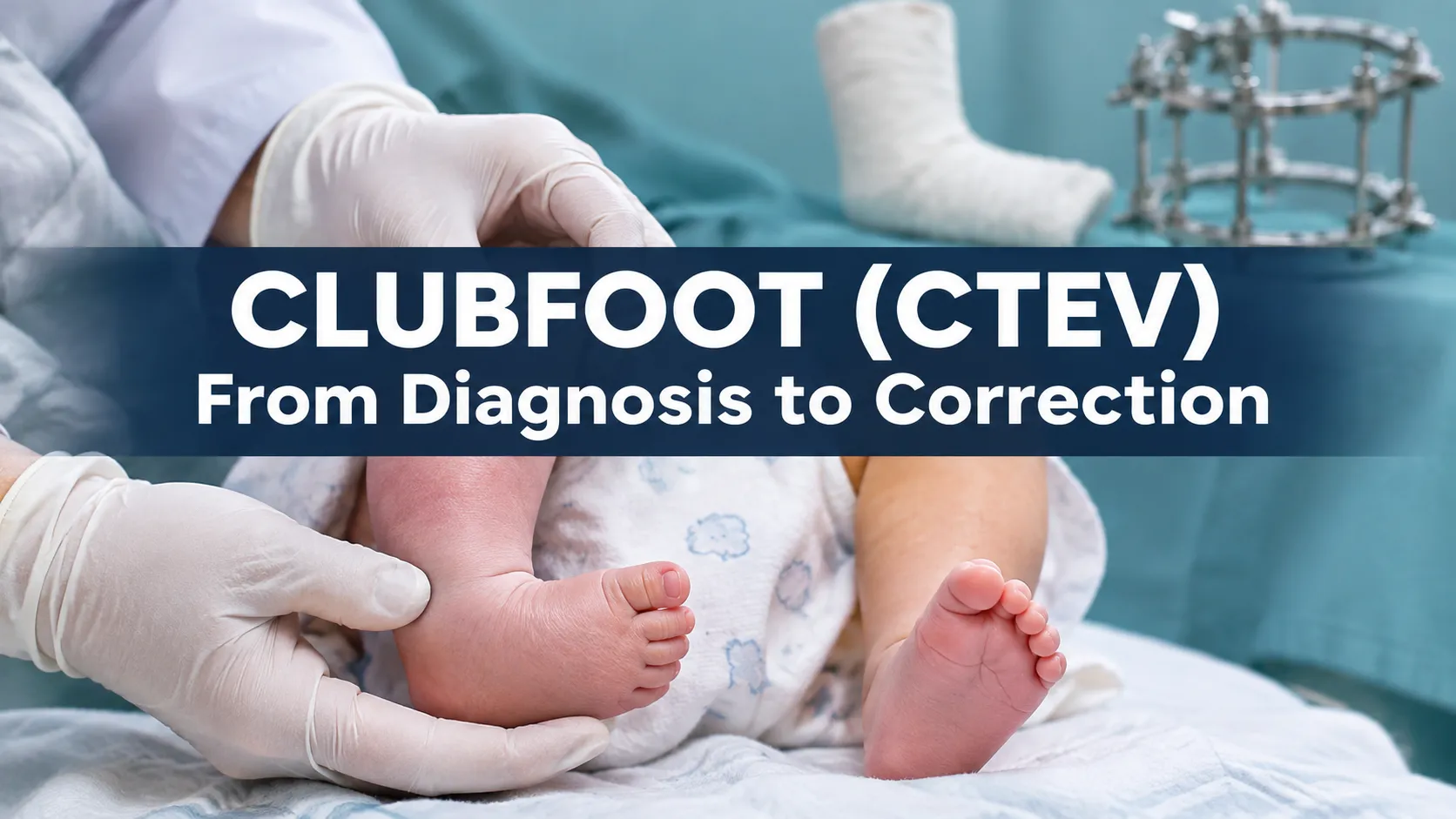
Learn about clubfoot treatment, CTEV causes, Ponseti casting, brace duration, relapse signs and surgical options for children and adults.
Finding out that your newborn has a twisted foot is frightening. The good news is that clubfoot is one of the most treatable birth differences in orthopaedics, and most babies go on to walk, run and play normally. Things are different for an older child or adult whose clubfoot was never treated, or came back after early care. That foot needs a more involved plan, but it can still be corrected.
This article explains what CTEV is, why it happens, how the Ponseti method works week by week, why relapse occurs, and what options exist when the foot is stiff, painful or neglected.
What Is Clubfoot (CTEV)?
Clubfoot, or congenital talipes equinovarus (CTEV), is a birth deformity in which the foot points down and twists inward, so the sole faces the other foot. The tendons on the inner and back side of the foot are too short and tight. Without treatment, a child walks on the outer edge or top of the foot.
The name breaks down simply:
- Talipes: ankle and foot
- Equinus: the heel is pulled up and the foot points down
- Varus: the heel turns inward
- Cavus and adductus: a high arch and a front foot that curves inward
Clubfoot affects roughly 1 in every 1,000 babies born. Boys are affected about twice as often as girls, and in about half of children both feet are involved.
If your child is older, or you are an adult living with a stiff or relapsed clubfoot, you can read about how we approach foot deformity correction before going further.
Causes and Risk Factors of Clubfoot
In most children, there is no single clear cause. Doctors call this idiopathic clubfoot, which simply means the reason is unknown. Research points to a mix of genes and conditions in the womb.
Factors linked to a higher chance of CTEV include:
- Family history: the risk rises if a parent or sibling had clubfoot
- Sex: boys are affected more often than girls
- Smoking during pregnancy: studies link maternal smoking with a higher risk
- Low amniotic fluid: less room in the womb may play a part in some cases
- Associated conditions: spina bifida, arthrogryposis and some genetic syndromes
One thing parents in India often worry about needs saying clearly. Clubfoot is not caused by anything the mother did or ate during a normal pregnancy, and it is not a curse or a sign of bad luck. It is a growth difference in the soft tissues of the leg.
Types of Clubfoot: Idiopathic, Syndromic and Positional

Not every inward-turned foot is true clubfoot. The type decides how the foot will respond to treatment.
1. Idiopathic (classic) clubfoot. The most common form. The child is otherwise healthy. The foot is stiff and cannot be moved into a normal position by hand. It responds very well to the Ponseti method.
2. Syndromic or neurogenic clubfoot. This occurs alongside another condition such as arthrogryposis, spina bifida or a nerve and muscle disorder. The foot is usually stiffer, needs more casts and is more likely to relapse. Surgery is needed more often.
3. Positional (postural) clubfoot. The foot looks turned in because of how the baby lay in the womb, but it is flexible. It can be gently moved to a normal position. It often settles with stretching or a few casts.
Signs and Diagnosis of Clubfoot
Clubfoot is often spotted on a routine pregnancy ultrasound around 18 to 20 weeks. The diagnosis is confirmed after birth with a simple physical examination. X-rays are rarely needed for a newborn.
Common signs at birth:
- The foot points down and inward
- A deep crease across the sole and above the heel
- The heel feels small and high
- The calf on that side may look thinner
- The foot stays stiff when gently stretched
The Pirani Score in Simple Terms
Many doctors use the Pirani score to measure how severe the foot is and to track progress. The doctor checks six features: three in the midfoot (curve of the outer border, crease on the inner sole, position of the talus bone) and three in the hindfoot (crease at the back, how empty the heel feels, how stiff the ankle is).
Each feature scores 0, 0.5 or 1. The total runs from 0 (normal) to 6 (most severe). A falling score at each visit shows the casts are working. A heel score that stays high usually signals the need for a small tendon release called a tenotomy.
Clubfoot Treatment: The Ponseti Method Explained
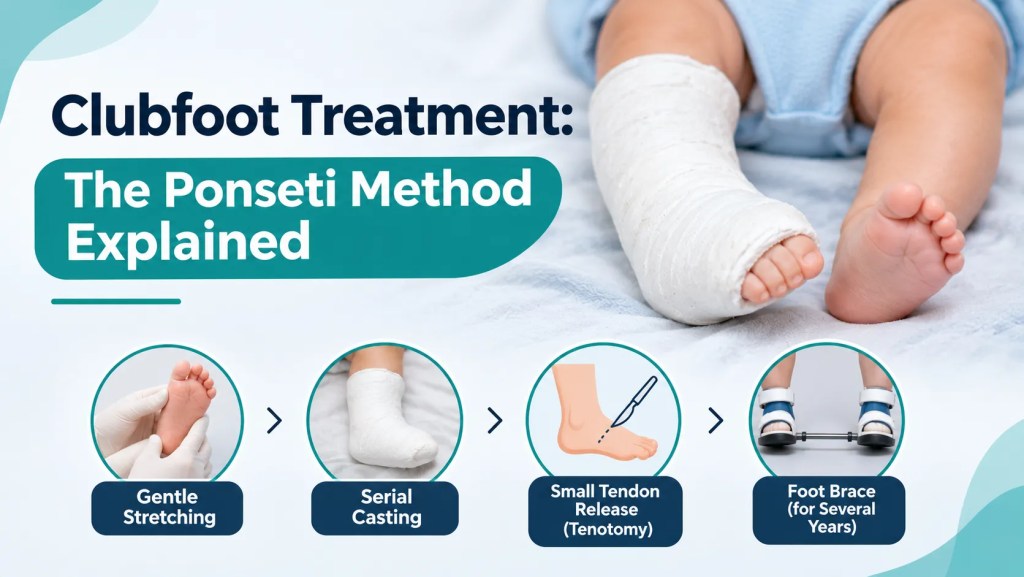
The Ponseti method is the standard first treatment for clubfoot worldwide. It uses gentle stretching, a series of plaster casts, a tiny tendon release in most babies, and a foot brace worn for several years. It works best when started in the first few weeks of life, though it can help children up to a few years old.
The idea is simple. Each week the doctor gently moves the foot a little closer to normal, then holds it there with a cast. The tight soft tissues slowly stretch. Bones in a baby’s foot are soft and reshape as the foot is held in a better position.
Ponseti Clubfoot Treatment: Week-by-Week Timeline
| Stage | Timing | What happens | What parents do |
|---|---|---|---|
| Casting begins | Week 1 (ideally within the first 2 to 3 weeks of birth) | Gentle stretch, then a long leg plaster cast from toes to upper thigh | Keep the cast dry and clean; check toes for colour and warmth |
| Serial casting | Weeks 2 to 6 | Cast changed once a week; the front foot is turned out step by step | Attend every weekly visit; missed visits slow correction |
| Tenotomy | Around week 5 to 7 | A small cut releases the tight Achilles tendon under local anaesthesia; needed in most babies | Very short procedure; baby usually feeds soon after |
| Final cast | 3 weeks after tenotomy | Foot held in its corrected position while the tendon heals | Normal cast care |
| Full-time bracing | Next 3 months | Boots joined by a bar (foot abduction brace) worn about 23 hours a day | Remove only for bathing; check skin daily |
| Night and nap bracing | Until about age 4 to 5 years | Brace worn during sleep only | Stay consistent even when the foot looks perfect |
Most babies need around five to seven casts before the tenotomy. The whole casting phase usually takes six to eight weeks.
Why the Brace Matters So Much
The brace is not optional. It holds the foot in a turned-out position so the tight tissues cannot pull it back. Not wearing the brace as advised is the single biggest reason clubfoot returns. Babies usually adjust to it within a few days. Many parents find it helps to make the brace part of the bedtime routine.
Clubfoot Relapse: Why It Happens and What to Do

A relapse means the foot starts turning in or pointing down again after successful correction. It usually shows up in the first few years.
Common reasons for relapse:
- The brace was stopped early or worn for fewer hours than advised
- The brace did not fit well as the child grew
- Muscle imbalance, often a strong tibialis anterior tendon pulling the foot inward
- Syndromic clubfoot, which tends to recur more often
Early warning signs parents can watch for:
- The child walks on the outer edge of the foot
- The heel does not touch the ground fully
- The foot curves inward when the child is walking
- The ankle feels stiffer than before
What to do: Do not wait. An early relapse in a young child is often treated by repeating a few Ponseti casts, sometimes with a second tenotomy. In a child aged around three or older, a procedure called a tibialis anterior tendon transfer may be advised to balance the muscles. Late or repeated relapse in older children may need bone surgery, which is covered in the next section.
Neglected and Adult Clubfoot: Correction With Ilizarov and Osteotomy
In India, many children with clubfoot never reach a Ponseti clinic. Some families are told the foot will straighten on its own. Others start casting but cannot keep up with weekly visits or bracing. These children grow into teenagers and adults who walk on the outer edge or even the top of the foot.
Neglected clubfoot is the term for a foot that was never treated or was only partly treated beyond infancy. By this stage the bones have grown into the twisted shape and the joints are stiff. Casting alone can no longer fix it.
What Problems Does Adult Clubfoot Cause?
- Thick, painful calluses and skin breakdown where the foot bears weight
- Difficulty finding footwear that fits
- Pain in the ankle, knee or back from an uneven walking pattern
- Early arthritis in the stiff joints
- Social discomfort and difficulty with work that involves standing or walking
Surgical Options for Neglected Clubfoot
The aim is a plantigrade foot: one that rests flat on the ground, bears weight without pain and fits into ordinary shoes. The right plan depends on age, stiffness, skin condition and any earlier surgery.
1. Gradual correction with the Ilizarov frame. For severe and stiff deformities, Ilizarov surgery is often the safest route. A circular external frame is fixed to the leg and foot with thin wires. Over several weeks, the frame is adjusted by small amounts each day to slowly untwist the foot. Because the correction is gradual, the nerves, blood vessels and skin get time to stretch. This lowers the risk of wound breakdown, which is a real concern with sudden correction in a rigid foot. The Ilizarov method can correct the foot with or without cutting the bones, and it avoids shortening the foot.
2. Corrective osteotomy. An osteotomy means a planned cut in the bone to change its shape. Surgeons may combine midfoot or heel osteotomies with soft tissue releases. In some cases the osteotomy is done first and the Ilizarov frame is then used to guide the correction slowly.
3. Joint fusion (arthrodesis). In adults with painful, arthritic and very stiff joints, fusing selected joints such as in a triple arthrodesis can give a stable, pain-free foot. It trades some movement for stability and comfort.
4. Tendon transfers and soft tissue releases. These are often added to keep muscles balanced and reduce the chance of the deformity returning.
Complex foot reconstruction of this kind is a core part of Dr. Divya Ahuja’s practice in Mumbai. You can learn more about Dr. Divya Ahuja’s experience in limb reconstruction and how each case is planned from standing X-rays and clinical assessment.
Conclusion
For babies treated with Ponseti: Most children walk at the normal age and take part in sports and daily activities. The treated foot may stay slightly smaller and the calf slightly thinner than the other side, especially when only one foot was affected. This rarely limits function. Regular follow-up until the child stops growing helps catch any relapse early.
After Ilizarov correction for neglected clubfoot: Recovery takes longer and needs commitment.
- Correction phase: the frame is adjusted daily for several weeks while the foot slowly moves into position
- Holding phase: the frame stays on while the tissues and any bone cuts settle
- After frame removal: a cast or boot is used for a short period, followed by physiotherapy
- Pin site care: daily cleaning to prevent infection is a key part of recovery
The total time in the frame varies with the severity of the deformity and whether bone cuts were needed. Most patients describe a foot that is flatter, less painful and easier to fit into shoes. Some stiffness is expected, and custom footwear or insoles may still help.
FAQs
Can clubfoot be cured completely?
Most idiopathic clubfoot can be corrected so the child walks and runs normally. The foot may stay slightly smaller and stiffer than average. Long-term success depends heavily on wearing the brace exactly as advised until age four or five.
What is the best age to treat clubfoot?
The ideal time to start Ponseti casting is within the first two to three weeks after birth, when the tissues are most flexible. Treatment still works in older infants and toddlers, though more casts may be needed.
Can adults with clubfoot be treated?
Yes. Adults with neglected or relapsed clubfoot can be treated with gradual Ilizarov correction, osteotomies, tendon transfers or joint fusion. The goal is a flat, pain-free foot that bears weight well and fits into ordinary footwear.
How long is the clubfoot brace worn?
The brace is worn about 23 hours a day for three months after the final cast. After that, it is worn during night sleep and naps until the child is around four to five years old.
Is the tenotomy painful for my baby?
The tenotomy is a quick procedure done under local or light anaesthesia. Babies may cry briefly, mostly from being held still. Most settle and feed soon afterwards. The small cut heals inside the final cast over three weeks.
Will my child be able to play sports?
Most children treated successfully with the Ponseti method play sports, run and dance like their peers. Some notice slightly less ankle flexibility or calf bulk on the treated side, but this rarely stops normal activity.
What is CTEV in medical terms?
CTEV stands for congenital talipes equinovarus. It describes a foot present from birth that points downward (equinus), turns inward at the heel (varus) and curves inward at the front, with a high arch on the inner side.
Can clubfoot come back after treatment?
Yes, relapse can happen, usually in the first few years and most often when bracing is stopped early. Early relapse is often managed with repeat casting. Later relapse may need a tendon transfer or bone surgery.
Is surgery always needed for clubfoot?
No. Most babies need only casting, a minor tenotomy and bracing. Larger surgery is usually reserved for stiff syndromic feet, repeated relapse, or neglected clubfoot in older children and adults where casting alone cannot correct the shape.
How long does Ilizarov treatment take for neglected clubfoot?
It depends on severity, age and whether bone cuts are needed. The frame typically stays on for several weeks to a few months, followed by a period in a cast or boot and physiotherapy before normal walking resumes.