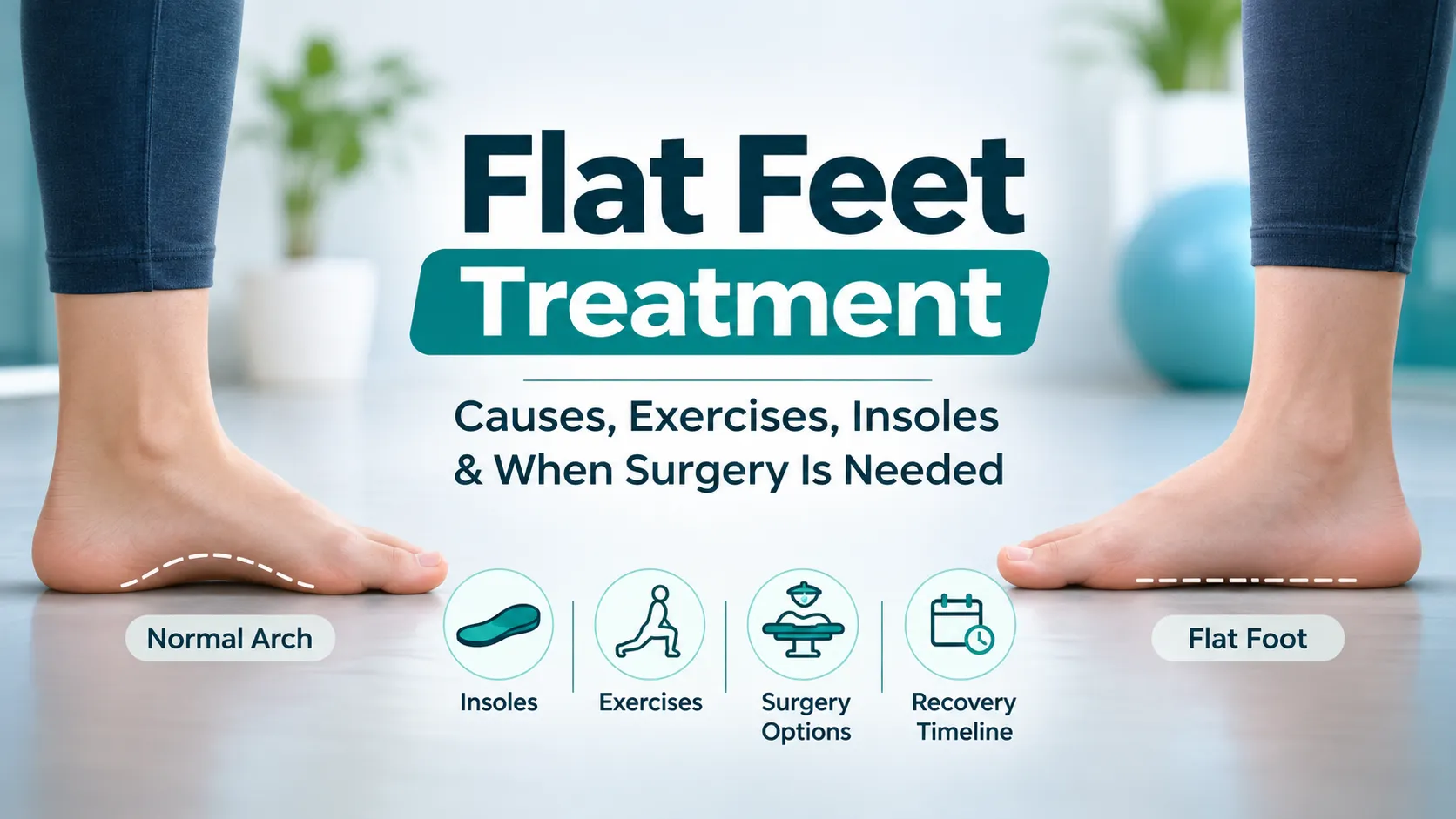
Flat feet treatment explained: flexible vs rigid flat foot, insoles that help, 7 exercises, and when flat foot surgery like osteotomy or fusion is needed.
Plenty of people have flat feet and never feel a thing. Others deal with aching arches, tired legs by evening, or a foot that seems to be getting flatter every year. If you are in the second group, the right flat feet treatment depends on what kind of flat foot you have, how old you are, and what is causing the pain.
This article walks through the types of flat foot, the common causes, which insoles and exercises actually help, and the point at which surgery becomes a sensible option.
What Are Flat Feet?
Flat feet (pes planus) is a condition in which the inner arch of the foot is low or absent, so most of the sole touches the ground when you stand. It can be present from childhood or develop in adulthood. Many flat feet cause no problems, but some lead to pain, fatigue and gradual deformity.
A quick home check: wet your feet and stand on a piece of paper or a dry floor. A normal print shows a curve on the inner side. A flat foot leaves an almost full footprint.
A second check tells you more. Stand on your tiptoes. If the arch appears when you rise up, the flat foot is likely flexible. If the arch stays flat, it may be rigid, and that needs a doctor’s assessment.
Flexible vs Rigid Flat Foot: Children vs Adults
The single most useful thing to know about your flat foot is whether it is flexible or rigid. That one fact shapes almost every treatment decision.
| Feature | Flexible flat foot (child) | Flexible flat foot (adult) | Rigid flat foot (any age) |
|---|---|---|---|
| Arch on tiptoe | Appears | Appears, may weaken over time | Stays flat |
| Common cause | Normal development, loose ligaments | Weak tendon, weight gain, ageing | Tarsal coalition, arthritis, old injury |
| Pain | Usually none | Arch, inner ankle or leg fatigue | Often painful, stiff hindfoot |
| Gets worse with time? | Usually improves by age 8 to 10 | Can progress, especially with PTTD | Often progresses |
| First treatment | Observation, good footwear | Insoles, exercises, weight control | Investigation, then targeted care |
| Surgery needed? | Rarely | Only if painful and progressive | More often |
Most babies and toddlers have flat-looking feet. The arch forms gradually through childhood. A flexible, pain-free flat foot in a young child is usually just a stage of normal growth.
If your foot is painful, stiff, or changing shape, it helps to have it assessed by a surgeon who handles foot deformity treatment so the cause is identified early.
Causes of Flat Feet
In children:
- Normal development and naturally loose ligaments
- Family history of flat feet
- Tarsal coalition: two foot bones are joined by an abnormal bridge of bone or cartilage, causing a stiff, painful flat foot, often noticed in the early teens
- Neuromuscular conditions such as cerebral palsy
In adults:
- Adult-acquired flatfoot deformity (AAFD), often due to posterior tibial tendon dysfunction (PTTD): the main tendon that supports the arch weakens, stretches or tears, and the arch slowly collapses. It is more common in women over 40, people with diabetes, high blood pressure or excess body weight
- Rheumatoid arthritis or osteoarthritis of the midfoot
- Old fractures of the ankle or foot that healed in a poor position
- Ligament injury and long-term overuse
- Pregnancy, when hormones loosen the ligaments
Symptoms: When Do Flat Feet Need Treatment?
A flat foot only needs treatment when it causes symptoms or keeps changing. Watch for:
- Pain along the inner arch or inner ankle
- Swelling behind the inner ankle bone
- Legs or feet that tire quickly when standing or walking
- Shoes wearing out unevenly on the inner side
- Heel pain, shin pain, or knee pain on the same side
- The foot rolling further inward or the toes pointing outward over time
- Difficulty standing on tiptoe on one leg
That last sign matters. If you cannot rise onto the toes of one foot, the posterior tibial tendon may be failing. Early treatment at this stage can prevent the foot from becoming stiff and deformed.
Your doctor will usually ask for standing (weight-bearing) X-rays of the foot and ankle. These show the true shape of the arch under load. An MRI or CT scan may be needed if a tendon tear or tarsal coalition is suspected.
Non-Surgical Flat Feet Treatment
Most painful flat feet improve without surgery. The aim is to support the arch, reduce strain on the tendons and build strength in the small muscles of the foot.
Insoles and Orthotics
Arch-support insoles do not create a permanent arch, but they reduce pain by supporting the foot while you wear them. Think of them as a support, not a cure.
- Off-the-shelf insoles with a firm arch and a deep heel cup work well for many mild cases
- Custom orthotics are moulded to your foot and help when the deformity is more marked or one foot differs from the other
- Medial heel wedges tilt the heel slightly outward and ease strain on the posterior tibial tendon
- Ankle braces (such as an ankle-foot orthosis) may be advised for more advanced adult flatfoot
Footwear
- Choose shoes with a firm heel counter that does not collapse when squeezed
- Look for a supportive midsole and enough room to fit an insole
- Avoid flat slippers and worn-out shoes for long hours of walking
- Barefoot walking on hard floors all day can worsen pain in adult flatfoot
Physiotherapy and Lifestyle
- Calf stretching to reduce pull on the arch
- Strengthening of the foot and hip muscles
- Weight management, since extra load speeds up tendon wear
- Short courses of anti-inflammatory medicine or rest in a boot during a painful flare, under medical advice
Flat feet sometimes travel with heel pain. If your main symptom is a sharp heel ache with the first steps in the morning, the cause may be plantar fasciitis and heel spur pain, which is treated a little differently.
7 Flat Feet Exercises That Help
These flat feet exercises strengthen the muscles that hold up the arch. They will not change the bone shape of a rigid flat foot, but they often reduce pain and fatigue in flexible flat feet. Do them once or twice a day and stop if any exercise causes sharp pain.
1. Short foot exercise. Sit with your foot flat on the floor. Without curling your toes, pull the ball of your foot towards your heel so the arch lifts slightly. Hold for 5 seconds. Repeat 10 times. Progress to doing it standing.
2. Heel raises. Stand holding a wall or chair. Rise slowly onto your toes, keeping the ankles from rolling outward, then lower over 3 seconds. Do 2 sets of 10 to 15. When this feels easy, try single-leg raises.
3. Towel curls. Place a small towel on the floor. Using only your toes, scrunch the towel towards you. Do this for about a minute per foot.
4. Calf stretch. Stand facing a wall with one foot back, heel down and knee straight. Lean forward until you feel a stretch in the calf. Hold 30 seconds, 3 times each side. Repeat with the back knee slightly bent.
5. Marble pick-up. Scatter 10 to 15 marbles on the floor. Pick them up one at a time with your toes and drop them into a bowl.
6. Toe yoga. Lift only the big toe while keeping the other toes down. Then press the big toe down and lift the others. Repeat 10 times. This builds control of the small foot muscles.
7. Single-leg balance. Stand on one foot near a wall for 30 seconds while keeping the arch gently lifted. Make it harder by closing your eyes or standing on a cushion.
If pain keeps getting worse despite four to six months of good insoles, footwear and regular exercise, it is time to talk about the next step.
When Is Flat Foot Surgery Needed?
Flat foot surgery is considered when pain and function stay poor after several months of proper non-surgical care, or when the foot is visibly collapsing or becoming rigid. It is not done simply to make a pain-free foot look different.
Common reasons to consider surgery:
- Persistent pain despite insoles, shoes and physiotherapy
- Progressive adult-acquired flatfoot from a failing posterior tibial tendon
- Painful tarsal coalition in a teenager
- Arthritis in the hindfoot or midfoot joints
- A rigid flat foot after an old fracture that healed in a poor position
Types of Flat Foot Surgery
Surgeons often combine more than one procedure. The choice depends on age, flexibility, tendon health and the state of the joints.
1. Osteotomy (reshaping the bone). The heel bone may be cut and shifted inward (a medial calcaneal displacement osteotomy) so the body weight passes through a better line. In some feet, the outer side of the heel bone is lengthened with a small bone graft to lift the arch. Osteotomies keep the joints moving, which makes them a good choice for flexible deformities. [Editor: link “osteotomy” to the Nov #7 osteotomy post once it is live.]
2. Tendon repair or transfer. A damaged posterior tibial tendon can be cleaned and repaired, or a neighbouring tendon (often the flexor digitorum longus) is moved across to take over its job. This is usually paired with an osteotomy.
3. Calf lengthening. A tight calf or Achilles tendon pulls the foot flat. Lengthening it relieves that pull.
4. Arthroereisis. A small implant is placed in the sinus tarsi, a space on the outer side of the hindfoot, to block excessive rolling in. It is mostly used in selected older children and teenagers with flexible flat feet that remain painful.
5. Tarsal coalition resection. The abnormal bony or cartilage bridge is removed so the joint can move again.
6. Fusion (arthrodesis). For rigid, arthritic or severe flat feet, selected joints are fused into a corrected position. A triple arthrodesis joins three hindfoot joints. It gives a stable, less painful foot but reduces side-to-side movement.
In severe or previously failed cases, a stepwise reconstruction, sometimes with gradual correction using an external frame, may be planned after careful assessment of standing X-rays.
Recovery Timeline After Flat Foot Surgery
Recovery is gradual. A typical pattern after reconstruction for adult flatfoot looks like this, though every plan is individual:
- Weeks 0 to 2: plaster splint, foot raised above heart level as much as possible, no weight on the foot, wound check
- Weeks 2 to 6: cast or boot, still no weight or only touch weight as advised
- Weeks 6 to 10: gradual weight bearing in a walking boot once X-rays show healing
- Weeks 10 to 16: back into supportive shoes with an insole, physiotherapy for strength and balance
- Months 4 to 6: most daily activities resume comfortably
- Up to 12 months: swelling continues to settle, and full benefit is felt
Smaller procedures such as arthrodesis or coalition resection usually recover faster. Fusions usually take longer because the bones must join solidly.
FAQs
Can flat feet be corrected in adults?
Painful flat feet in adults can usually be managed with insoles, footwear, and exercises. When the arch keeps collapsing or pain persists, surgery such as osteotomy, tendon transfer or fusion can rebuild a better-aligned, more comfortable foot.
Are flat feet a problem for army or police selection?
Medical standards differ between forces and change over time. Some recruitment boards check for flat feet, especially rigid or painful ones. Read the latest official medical standards for your exam and get a proper foot assessment well before your medical test.
Do insoles fix flat feet permanently?
No. Insoles support the arch and ease pain while you wear them, but they do not reshape the bones. They work best alongside strengthening exercises, good shoes and weight control, especially in flexible flat feet.
Is flat foot surgery worth it?
For people with ongoing pain and a progressive or rigid deformity that has not improved with months of proper care, surgery often brings meaningful relief. It is not advised for flat feet that cause no symptoms.
Do children grow out of flat feet?
Most children with flexible, pain-free flat feet develop an arch by around eight to ten years of age. A child with a stiff, painful or one-sided flat foot should be examined by an orthopaedic surgeon.
How long do flat feet exercises take to work?
Most people notice less fatigue and pain after six to eight weeks of daily exercise. Strength keeps improving for several months. Exercises help most when combined with supportive footwear and, if needed, an arch-support insole.
Can flat feet cause knee or back pain?
They can contribute. When the foot rolls inward, the shin rotates, and the knee takes extra strain. Some people also feel hip or lower back discomfort. Supporting the foot often eases these linked aches.
What is posterior tibial tendon dysfunction?
It is a condition where the main tendon supporting the inner arch becomes inflamed, stretched, or torn. The arch slowly collapses. It is the most common cause of flat foot that develops for the first time in adults.
Which X-ray is needed for flat feet?
Standing, weight-bearing X-rays of the foot and ankle are needed. They show how the arch behaves under body weight. An X-ray taken lying down can hide the true degree of collapse and lead to an inaccurate assessment.
Can I walk normally after flat foot surgery?
Most patients walk in a boot by six to ten weeks and return to supportive shoes by around three to four months. Full recovery, with swelling settled and strength restored, often takes six to twelve months.