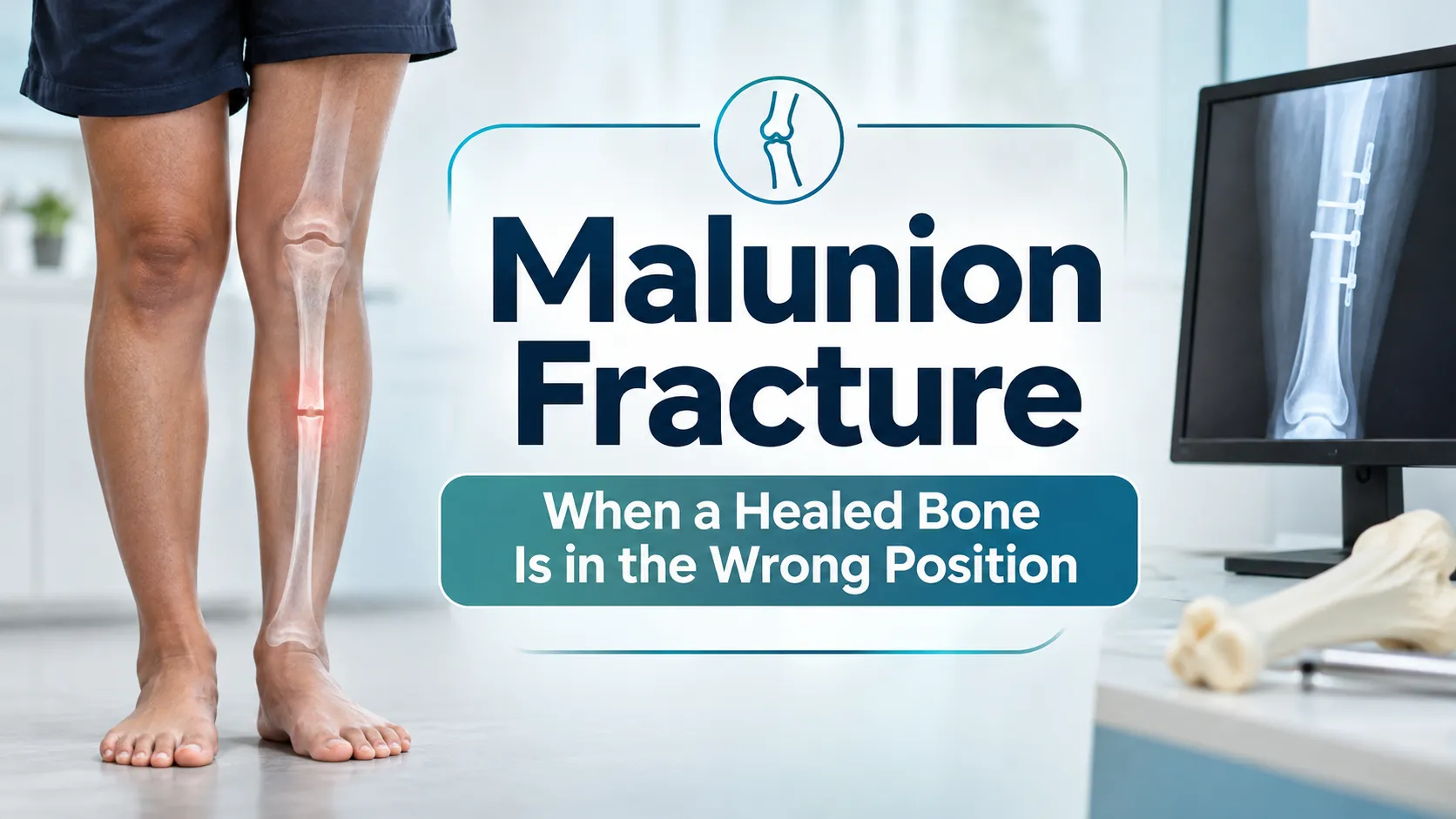
Malunion fracture means a bone healed crooked or short. Learn causes, how it differs from nonunion & correction with osteotomy or Ilizarov surgery.
The plaster came off months ago. The X-ray report says the bone has healed. Yet your leg looks bent, your foot points the wrong way, or one leg is now shorter than the other. You limp, and the knee or ankle aches by the end of the day.
This is a malunion fracture: a bone that has joined, but in the wrong position. It is one of the most common reasons patients come for a second opinion after a fracture treated elsewhere. The encouraging part is that a malunion can usually be corrected, even years after the original injury.
What Is a Malunion?
A malunion is a fracture that has healed in an abnormal position, with the bone bent, twisted, overlapped or shortened compared to its normal shape. The bone is solid and strong, but its alignment is wrong. This changes how weight passes through the joints above and below, and it can affect walking, appearance and long-term joint health.
A malunion can affect any bone. In the legs, it is most noticeable in the thigh bone (femur), shin bone (tibia), ankle and around the knee. In the arms, it often involves the forearm and wrist, where it can limit rotation and grip.
Not every small imperfection is a problem. Bones heal with some minor angle in many fractures, and the body adapts well. A malunion matters when the deformity is large enough to cause pain, a limp, a visible deformity or strain on nearby joints.
Malunion vs Delayed Union vs Nonunion
These three terms describe different ways fracture healing can go wrong. They are often confused, but the treatment for each is quite different.
| Feature | Malunion | Delayed union | Nonunion |
|---|---|---|---|
| Has the bone healed? | Yes, but in the wrong position | Not yet, healing is slower than expected | No, healing has stopped |
| Typical timeline | Seen once the fracture has joined | Not healed by the usual expected time for that bone | No progress on X-rays over several months |
| Main problem | Angulation, rotation or shortening | Slow progress, ongoing pain | Persistent pain, movement at the fracture site |
| Is the limb stable? | Stable but misaligned | May be tender or weak | Often unstable or painful to bear weight on |
| Common treatment | Corrective osteotomy, Ilizarov gradual correction | Protect, optimise healing, sometimes surgery | Surgery to stimulate healing, bone graft, stable fixation |
If your bone has not joined at all after many months, that is a different situation. You can read about nonunion fracture treatment for that problem. Some patients have both, for example a bone that is crooked and also not fully healed, and both issues are planned together.
Causes of Malunion
- Poor reduction: the broken pieces were not lined up accurately before the plaster or fixation was applied.
- Loss of position in plaster: a fracture that was well aligned on day one can slip inside a cast as swelling reduces, especially if follow-up X-rays are missed.
- Early weight bearing: walking on an unprotected fracture before it is strong enough can bend or shorten it.
- Untreated fractures: some fractures are never diagnosed, particularly in children, the elderly, or after a fall that seemed minor.
- Traditional bonesetter treatment: in India, many fractures are first treated by traditional bonesetters using tight bandages and splints. Without X-ray guidance, the bone often heals bent or short. Tight bandaging can also damage skin, nerves and blood supply.
- Complex or high-energy fractures: crushed or multi-fragment fractures are harder to hold in perfect alignment. Our approach to complex fracture treatment focuses on preventing this.
- Implant failure or infection: a loose plate or nail, or an infection, can allow the bone to drift before it heals.
- Growth plate injuries in children: a fracture through the growth plate can cause the bone to grow crooked or short over the following years.
To understand how different breaks behave, it helps to know the main types of fractures and why some are more prone to healing out of line.
Symptoms of a Malunion Fracture
A malunion can show up as one or more of these deformities:
- Angulation: the bone is bent forward, backward, inward or outward. In the leg, this can cause bow legs or knock knees on one side.
- Rotation: the bone is twisted, so the foot or hand points in an abnormal direction. Patients often notice their foot turning out or in when walking.
- Shortening: the broken ends overlapped as they healed, so the limb is shorter. Even a modest difference can cause a noticeable limp.
- Translation: the bone ends have healed side by side rather than end to end.
Common complaints include:
- A visible bend or twist in the limb
- Limping or tiring quickly when walking
- Pain in the knee, ankle, hip or back from abnormal loading
- Difficulty with stairs, squatting or sitting cross-legged
- Uneven shoe wear
- In the arm: weak grip or difficulty turning the palm up or down
How Malunion Is Diagnosed
A careful plan starts with measuring the deformity exactly. Guesswork leads to under-correction or new problems.
- Clinical examination: the surgeon checks limb length, the angle of the knee and ankle, how the foot points when walking, joint movement and the condition of the skin and old scars.
- X-rays in two views: show the healed fracture, the angle of deformity and the condition of the nearby joints.
- Long-leg standing X-ray (full-length alignment film): a single X-ray from hip to ankle taken while standing. It shows the mechanical axis of the whole leg, the exact level of the deformity, and any shortening. This is the most important test for leg malunions.
- CT scan: measures rotation precisely and helps plan complex corrections, especially near joints.
- Blood tests and infection screening: important if there were earlier operations, wounds or discharge.
With these measurements, the surgeon identifies the centre of rotation of angulation (CORA), the exact point where the bone needs to be corrected. This guides where to cut the bone and how much to move it.
Malunion Treatment: How a Crooked Bone Is Corrected
Not every malunion needs surgery. A small deformity that causes no pain or functional problem can simply be monitored. Shoe raises can help with mild shortening. Physiotherapy can strengthen muscles and ease joint strain.
Surgery is advised when the malunion causes pain, a significant limp, visible deformity, joint overload, or a high risk of early arthritis.
1. Corrective Osteotomy
An osteotomy is a planned, controlled cut through the bone at the level of the deformity. The surgeon then realigns the bone into its correct position. Different techniques suit different shapes of deformity, such as a wedge osteotomy for simple angulation, or a dome osteotomy for correction around the centre of the deformity. [Editor: link “osteotomy” to the Nov #7 osteotomy post once it is live.]
2. Acute Correction With Plating or Nailing
For many moderate deformities, the bone is corrected in one operation and held with a plate and screws or an intramedullary nail (a rod inside the bone). This is suitable when:
- The deformity is moderate
- There is little or no shortening
- The skin and soft tissues are healthy
- There is no active infection
3. Ilizarov Gradual Correction
For large, complex or multi-plane deformities, gradual correction with an Ilizarov or hexapod frame is often the safer and more accurate option. After a small bone cut, a circular external frame is fixed to the limb. The frame is adjusted by tiny amounts each day, slowly straightening, untwisting and if needed lengthening the bone.
This approach is especially useful when:
- The limb is also short and needs lengthening at the same time
- The deformity is in more than one plane, for example bent and twisted
- The skin is scarred or poor quality after earlier injury or surgery
- There is a history of infection, where internal plates carry higher risk
- Previous surgery has already failed
Because the correction is gradual, nerves and blood vessels adapt safely. Correction can also be fine-tuned during treatment based on X-rays, which improves accuracy. Learn more about Ilizarov treatment for deformity correction.
4. Joint-Level Procedures
When a malunion near a joint has already caused advanced arthritis, the surgeon may combine realignment with joint procedures, or in some cases consider joint replacement or fusion as part of a staged plan.
Recovery Timeline After Malunion Correction
Recovery depends on the bone involved, the size of the correction, and whether lengthening is needed. A corrected bone has to heal again, much like a fresh fracture.
After acute correction with a plate or nail (typical leg osteotomy):
- Weeks 0 to 2: hospital stay of a few days, wound care, walking with a walker or crutches with limited weight on the leg
- Weeks 2 to 6: stitch removal, gentle joint movement and muscle exercises
- Weeks 6 to 12: gradually increasing weight bearing as X-rays show healing
- Months 3 to 6: most patients walk without support and return to work; strength keeps building
- Months 6 to 12: full recovery, including more demanding activities
After Ilizarov gradual correction:
- Latency phase (about 5 to 10 days): rest after the bone cut before adjustments begin
- Correction or lengthening phase: daily small adjustments to the frame; lengthening usually progresses at about 1 mm a day
- Consolidation phase: the frame stays on while the new bone hardens; this often takes longer than the correction itself
- Frame removal: a short procedure, followed by a period of protected walking and physiotherapy
Throughout treatment, regular X-rays, pin site care, physiotherapy and good nutrition all support healing. Stopping smoking makes a real difference, as smoking slows bone healing.
Most patients regain a straighter limb with more even weight distribution, less pain and a more natural walk. Correcting the alignment also reduces abnormal stress on nearby joints, which may lower the risk of future arthritis.
Frequently Asked Questions About Malunion
Can a malunion fracture be fixed years later?
Yes. A malunion can be corrected many years after the original fracture. The bone is cut at the level of deformity and realigned, either in one step or gradually with an Ilizarov frame. Joint health affects the final outcome.
Does malunion cause arthritis?
It can. When a bone heals crooked, weight passes unevenly through the knee, ankle or hip. Over time, this extra load can wear down the cartilage on one side and lead to earlier arthritis in the affected joint.
Is surgery always needed for malunion?
No. Small deformities that cause no pain or functional problem may only need monitoring, physiotherapy or a shoe raise. Surgery is advised when the malunion causes pain, a limp, visible deformity or strain on nearby joints.
What is the difference between malunion and nonunion?
In a malunion, the bone has healed but in the wrong position. In a nonunion, the bone has not healed at all and the fracture remains open. They need different treatments, though some patients have both problems together.
Can a malunion be corrected without surgery?
Once the bone has fully healed, its shape cannot be changed without surgery. Non-surgical measures such as shoe raises, braces and physiotherapy can ease symptoms, but they do not straighten the bone itself.
Can a shortened leg from malunion be lengthened?
Yes. With the Ilizarov method, the surgeon can correct the angle and lengthen the bone at the same time. New bone forms gradually in the gap as the frame is adjusted, restoring more equal leg length.
My fracture was treated by a bonesetter and healed crooked. What now?
Get a full clinical examination and standing X-rays. Many such malunions can be corrected with osteotomy or gradual Ilizarov correction. The earlier this is assessed, the better the chance of protecting nearby joints from further damage.
How long does it take to walk after malunion surgery?
Most patients start walking with support within days. Full weight bearing usually returns between six weeks and three months for acute correction. With Ilizarov treatment, patients often walk with support while the frame is on.
Is malunion correction surgery risky?
Like any surgery, it carries risks such as infection, delayed healing, stiffness or nerve irritation. Careful planning, gradual correction where needed, and regular follow-up keep these risks low. Your surgeon will explain risks specific to your case.
Which tests are needed to plan malunion surgery?
Usually X-rays in two views, a long-leg standing X-ray for leg deformities, and often a CT scan to measure rotation. Blood tests may be needed if there were previous operations, wounds or any concern about infection.