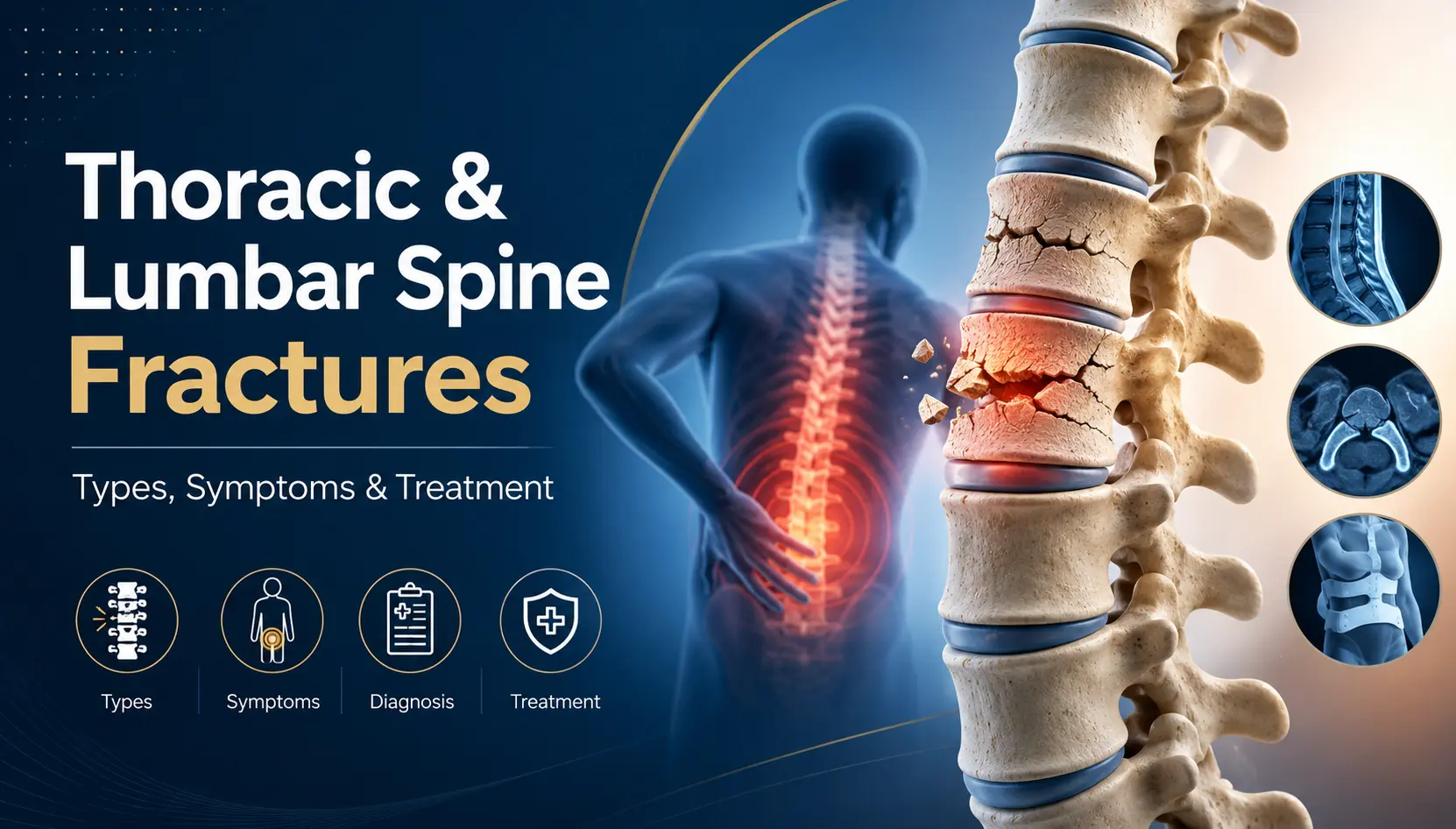
A fracture of the thoracic or lumbar spine is a serious orthopedic injury that can range from a stable compression fracture in an older adult to a life-threatening burst fracture or fracture-dislocation after a road accident. Most cases need urgent evaluation to check for spinal cord injury and to decide between bracing and surgery.
This detailed guide, written from the clinical perspective of Dr. Divya Ahuja, a Mumbai-based orthopedic and Ilizarov surgeon, explains the anatomy of the thoracic and lumbar spine, the different types of fractures, how they present, and what modern treatment involves. Any suspected spinal fracture is a medical emergency and should be assessed at a hospital equipped for trauma and spine care.
Anatomy of the Thoracic and Lumbar Spine
The human spine is a column of 33 bones called vertebrae, divided into three regions: cervical (neck), thoracic (mid-back), and lumbar (lower back). Below the lumbar spine sit the sacrum and coccyx.
- The thoracic spine has 12 vertebrae (T1 to T12) and is attached to the ribs, giving it natural stability
- The lumbar spine has 5 vertebrae (L1 to L5), the largest in the spine, which carry most of the body’s weight
- The thoracolumbar junction (T11 to L2) is a common site of fractures because it is the transition between the stiff thoracic spine and the mobile lumbar spine
Each vertebra has a rounded vertebral body in front, and a bony arch at the back that surrounds and protects the spinal cord. Injuries here can damage not only bone but also nerves, ligaments, and the spinal cord itself.
Causes of Thoracic and Lumbar Spine Fractures
High-Energy Trauma
Most spine fractures in younger adults happen due to a sudden, powerful force. Common causes include:
- Road traffic accidents involving cars, two-wheelers, or trucks
- Falls from a significant height, such as from a ladder, roof, or construction site
- Sports and adventure injuries such as diving into shallow water or heavy tackles
- Direct trauma from heavy objects
- Violence, including gunshot wounds and assaults
Patients hurt in high-energy accidents often have multiple injuries. Head, chest, abdominal, pelvic, and limb injuries commonly occur alongside a spinal fracture and may need urgent attention first.
Low-Energy Fractures in Osteoporosis
In older adults, especially post-menopausal women, spine fractures can happen with far less force. Weakened bones can crack from a minor fall, a hard cough, or even from lifting a small weight. These are called osteoporotic vertebral compression fractures, and they most commonly affect the thoracolumbar junction. Cancers, prolonged steroid use, and certain metabolic conditions can also weaken the vertebrae.
Types of Thoracic and Lumbar Spine Fractures
Spine surgeons classify these fractures based on the direction of force and the pattern of injury.
1. Compression Fracture
A compression fracture occurs when the front of the vertebra collapses under a downward force. It is usually stable and often affects patients with osteoporosis. Neurological injury is uncommon.
2. Burst Fracture
In a burst fracture, both the front and back of the vertebral body break, often after landing on the feet from a height. Bone fragments can push backward into the spinal canal, causing nerve or spinal cord injury. Burst fractures may be stable or unstable, and surgery is often required.
3. Flexion-Distraction (Chance) Fracture
A Chance fracture happens when the spine is violently bent forward while the pelvis is held in place, classically in a lap-belt car crash. The vertebra is pulled apart from behind. These injuries are usually unstable and typically need surgery.
4. Transverse Process Fracture
The transverse processes are small bony extensions on the sides of each vertebra. They can break from a rotational force or a hard sideways blow. These fractures are usually stable, do not affect the spinal cord, and heal without surgery.
5. Fracture-Dislocation
This is the most severe pattern, where one vertebra slips out of position relative to the next. It results from very high-energy trauma and often causes serious spinal cord injury and paralysis. Emergency surgical stabilisation is almost always needed.
Comparison Table: Spinal Fracture Patterns at a Glance
| Fracture Type | Typical Cause | Stability | Nerve Risk | Usual Treatment |
|---|---|---|---|---|
| Compression | Osteoporosis, fall | Stable | Low | Bracing, physiotherapy |
| Burst | Fall from height | Variable | Moderate to high | Bracing or surgery |
| Chance (flexion-distraction) | Lap-belt car crash | Unstable | Moderate | Surgery |
| Transverse process | Rotation, sideways blow | Stable | Very low | Rest, gradual mobilisation |
| Fracture-dislocation | Major trauma | Highly unstable | Very high | Emergency surgery |
Symptoms and Red Flags

The main symptom of a thoracic or lumbar spine fracture is moderate to severe back pain, worse with movement and better with lying still. However, other signs are just as important because they point to spinal cord or nerve involvement.
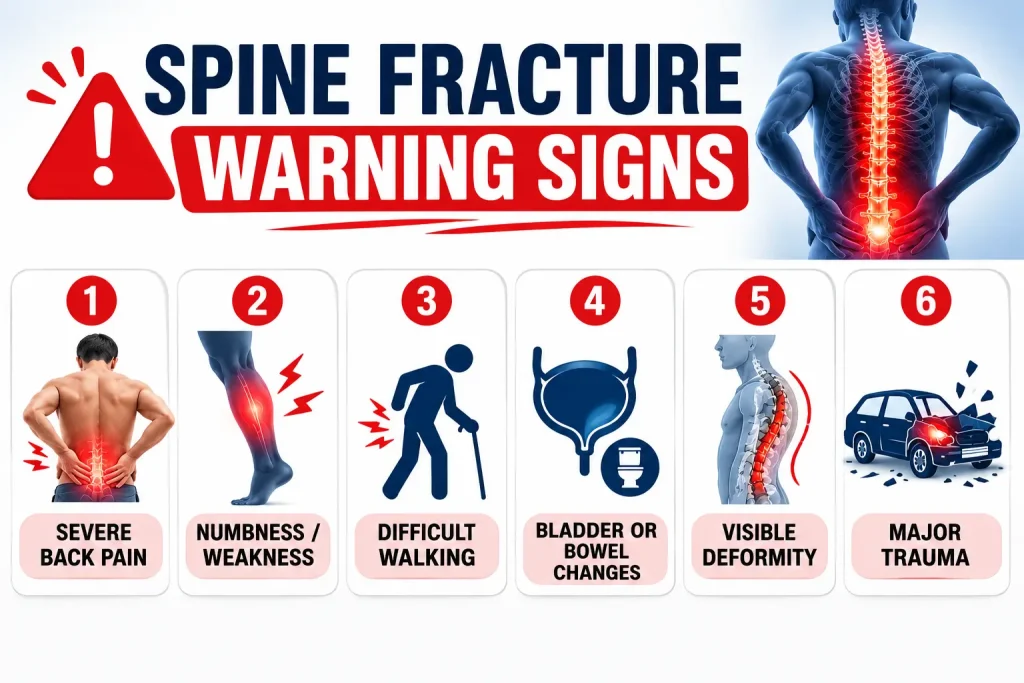
Warning symptoms that need emergency care include:
- Severe mid or lower back pain after any trauma
- Numbness, tingling, or weakness in the legs
- Loss of control over urine or stool
- Difficulty walking or standing
- Deformity or step-off felt along the spine
- Loss of consciousness at the time of injury
- Multiple injuries after a road accident, even without obvious back pain
Any person who has lost consciousness in a high-energy accident should be treated as if a spinal fracture is present until imaging confirms otherwise.
How Spinal Fractures Are Diagnosed
Diagnosis starts at the accident scene, where emergency responders immobilise the patient on a backboard with a cervical collar to prevent further injury. At the hospital, evaluation includes:
- Detailed history of how the injury occurred
- Neurological examination to check power, sensation, reflexes, and bladder or bowel involvement
- X-rays of the thoracic and lumbar spine to identify obvious fractures and alignment
- CT scan, which is the best test to show the exact pattern and displacement of bony fragments
- MRI scan to evaluate the spinal cord, nerves, ligaments, and disc injury
Accurate classification of the fracture, its stability, and any neurological injury guides the treatment plan.
Treatment of Thoracic and Lumbar Spine Fractures
Emergency Care
The priority is life. The trauma team stabilises breathing, controls bleeding, and manages other injuries such as chest, abdominal, pelvic, and limb trauma. Only once the patient is stable is the spine fracture addressed definitively.
Nonsurgical Treatment
Many stable fractures heal well without surgery. Options include:
- Bracing with a thoracolumbosacral orthosis (TLSO) for six to twelve weeks
- Pain management with medications and, in osteoporotic cases, calcium, vitamin D, and bone-strengthening therapy
- Bed rest followed by gradual, supervised mobilisation
- Physiotherapy to rebuild core strength, posture, and mobility
Isolated compression fractures and transverse process fractures fall into this group most often.
Surgical Treatment
Surgery is performed by a spine surgeon and is generally indicated for:
- Unstable burst fractures with major deformity or significant bone in the spinal canal
- Chance fractures with ligament disruption
- Fracture-dislocations
- Any fracture causing progressive neurological deficit
Common procedures include posterior spinal decompression and instrumented fusion using pedicle screws and rods, laminectomy to relieve pressure on the cord, and, in selected osteoporotic fractures, minimally invasive vertebroplasty or kyphoplasty. The goals are to realign the spine, relieve pressure on the spinal cord, provide a stable construct, and allow early mobilisation.
Complications and Recovery
Recovery from a spinal fracture is slow and multidisciplinary. Common complications to watch for include:
- Deep vein thrombosis and pulmonary embolism from prolonged immobility
- Pneumonia, especially in older patients
- Pressure sores from bed rest
- Persistent back pain and stiffness
- Progressive kyphotic (forward-bent) deformity
- Nonunion, hardware failure, or wound infection after surgery
- Neurological deficits, ranging from mild weakness to permanent paralysis in severe injuries
Rehabilitation focuses on pain control, restoring safe mobility, strengthening the trunk and legs, and returning the patient to work and daily life. Osteoporosis treatment is essential for patients whose fracture was caused by weak bones, since the risk of another fracture is very high without it.
When to Consult an Orthopedic Doctor
Any suspected thoracic or lumbar spine fracture should be taken directly to a hospital emergency department. Do not attempt to move the patient without proper support. Definitive spine fracture surgery is performed by a spine subspecialist, not by a limb-focused orthopedic surgeon.
Dr. Divya Ahuja, MS Ortho, is a Mumbai-based orthopedic and Ilizarov surgeon whose practice at the Center for Limb Lengthening and Reconstruction, Mangal Anand Hospital, Chembur, focuses on complex limb trauma, deformity correction, and post-injury reconstruction. In the context of spinal injuries, Dr. Ahuja can be a useful point of contact for:
- Second-opinion evaluation of imaging and treatment options
- Coordinated care in polytrauma patients where limb, pelvic, or hip fractures accompany a spine fracture
- Long-term rehabilitation planning after spinal injury
- Management of associated lower-limb fractures, nonunions, or deformities during recovery
For definitive spine surgical care, he refers patients to established spine subspecialists within his hospital network. To book an evaluation, visit the orthopedic clinic in Mumbai.
Conclusion
Thoracic and lumbar spine fractures range from stable compression injuries that heal with bracing to unstable fracture-dislocations that need urgent, expert spine surgery. Prompt diagnosis, careful classification, and coordinated care determine long-term outcomes. If you or a family member has suffered a spinal injury, or you need an orthopedic opinion during recovery from complex trauma, consult Dr. Divya Ahuja for a considered evaluation and referral to the right specialists.
Frequently Asked Questions (FAQs)
What is a thoracic or lumbar spine fracture?
A thoracic or lumbar spine fracture is a break in one of the vertebrae of the mid or lower back. It usually results from high-energy trauma such as road accidents or falls from height, or from weakened bones in osteoporosis.
What are the main types of spinal fractures?
The main types are compression fractures, burst fractures, flexion-distraction (Chance) fractures, transverse process fractures, and fracture-dislocations. Each has a different mechanism, stability profile, and risk of spinal cord injury, and treatment varies accordingly.
What is an L1 fracture?
An L1 fracture is a break in the first lumbar vertebra, at the thoracolumbar junction. It is one of the most common sites for compression and burst fractures because this area is the transition between the stiff thoracic and mobile lumbar spine.
Can a spinal fracture heal without surgery?
Yes. Stable compression fractures, transverse process fractures, and many stable burst fractures heal well with bracing, pain management, and progressive physiotherapy. Unstable fractures, fracture-dislocations, and injuries with nerve involvement usually need surgical stabilisation.
What is a burst fracture of the spine?
A burst fracture occurs when the vertebral body breaks in multiple directions under an axial load, often after a fall from height. Bone fragments can push into the spinal canal, sometimes causing nerve or spinal cord injury and needing urgent surgery.
What are the symptoms of a spinal fracture?
Symptoms include severe back pain worsened by movement, tenderness over the injured area, numbness or weakness in the legs, and, in serious cases, loss of bladder or bowel control. Any of these after trauma needs immediate evaluation.
How is a thoracic or lumbar spine fracture diagnosed?
Diagnosis combines clinical and neurological examination with imaging. X-rays give a first look, CT scans define the fracture pattern in detail, and MRI is used to assess the spinal cord, nerves, ligaments, and any disc injury caused by the fracture.
What is the recovery time after a spine fracture?
Recovery depends on severity. Stable fractures usually heal in three to six months with bracing and physiotherapy. Surgical cases may need six to twelve months of rehabilitation before returning to full function, and some patients experience long-term back pain.
Are spinal compression fractures serious?
Osteoporotic compression fractures are usually stable, but they signal fragile bones and a high risk of further fractures. Prompt evaluation, pain management, and treatment for osteoporosis are essential to prevent progressive deformity and future spine injuries.
When should I see a doctor for back pain after an accident?
Seek emergency care for any back pain after a road accident, fall from height, or direct trauma, especially with leg weakness, numbness, or bladder problems. Do not attempt to move the injured person without proper spinal support.